
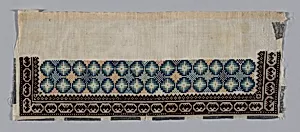
Woman's Trouser Band
Qing dynasty (1644–1911), 1875/1900
Medium
Embroidered in shades of blue and black on gauze.
Dimensions
14.2 × 33.5 cm (5 5/8 × 13 1/4 in.)
Classification
textile
Department
Textiles
Museum
Art Institute of Chicago
Accession Number
22080
Rights
Public Domain
Art Historical Context
This delicate *Woman's Trouser Band*, crafted by Han-Chinese artisans during China's Qing dynasty (1644–1911) around 1875–1900, exemplifies the exquisite textile traditions of late imperial China. Measuring just 14.2 ×33.5 cm, this narrow strip was likely used to cinch or adorn the waistband of women's trousers, a practical yet decorative element of everyday Han attire. During the Qing era, such garments blended functionality with artistry, reflecting the Manchu-influenced court's emphasis on refined craftsmanship amid social and cultural shifts. Embroidered in subtle shades of blue and black on translucent gauze—a lightweight silk weave prized for its breathability and sheen—the band showcases masterful needlework techniques. Gauze provided an ideal canvas for intricate patterns, allowing stitches to create depth and texture without overwhelming the fabric's delicacy. This monochromatic palette evokes elegance and restraint, hallmarks of Qing textile design, where embroidery served as both personal expression and a marker of skill, often produced by women in domestic settings. Housed in the Art Institute of Chicago's Textiles Department, this piece highlights the cultural significance of embroidery as a feminine art form, symbolizing virtue, prosperity, and family heritage. It offers visitors a intimate glimpse into the daily lives and aesthetic sensibilities of Qing women, bridging the gap between utility and high art.
About the Artist
Han-Chinese
**Han-Chinese** was the collective attribution given to anonymous artisans of Han Chinese descent who crafted intricate embroidered textiles during the Qing dynasty (1644–1911). These makers, active primarily in the late 18th to early 20th centuries, specialized in luxurious garments and furnishings that showcased the pinnacle of Han Chinese needlework traditions. Their early lives and individual ...