
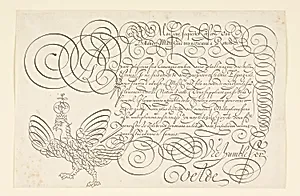
Writing Example from Spieghel der Schrijfkonste. Tweede Deel (The Mirror of Art Writing, Second Part)
Medium
graphic design
Classification
graphic design
Department
Smithsonian Collection
Museum
Smithsonian American Art Museum
Credit
Gift of William J. Donald
Accession Number
1954-18-30
Rights
Public Domain
About this artwork
Research in Progress
Art Historical Context
Visitors to the Smithsonian American Art Museum can admire *Writing Example from Spieghel der Schrijfkonste. Tweede Deel (The Mirror of Art Writing, Second Part)*, a delicate graphic design by Netherlandish artist Jan van de Velde I (1569–1623). Created in 1609, this work is part of a renowned calligraphy manual that served as a "mirror" for aspiring scribes, showcasing exemplary scripts and lettering styles through precise engravings. Van de Velde, a skilled engraver from the early Dutch Golden Age, captured the elegance of period handwriting, bridging art and utility. In the context of 17th-century Northern Europe, such writing books were essential tools for education and trade, reflecting the era's fascination with typography amid the printing press revolution. Van de Velde's meticulous line work highlights engraving techniques that allowed for reproducible, high-fidelity models of cursive and formal scripts, influencing graphic design precursors. This piece underscores the cultural value placed on mastery of the pen, blending aesthetic beauty with practical instruction. Generously gifted by William J. Donald to the Smithsonian Collection, this artwork invites reflection on how everyday skills like writing were elevated to fine art. Though research continues, it remains a window into the artistry of communication in Renaissance Holland.