
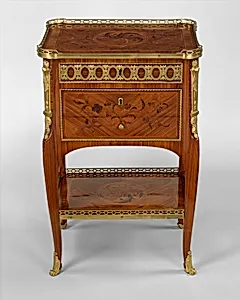
Writing table
ca. 1760–70
Medium
Oak, veneered with rosewood, endcut kingwood, banding of holly, gilt-bronze
Dimensions
28 3/4 x 18 1/4 x 13 1/2 in. (73 x 46.4 x 34.3cm)
Classification
Woodwork-Furniture
Culture
French, Paris
Department
European Sculpture and Decorative Arts
Museum
Metropolitan Museum of Art, New York, NY
Credit
The Jack and Belle Linsky Collection, 1982
Accession Number
1982.60.62
Rights
Public Domain
Art Historical Context
This elegant writing table, crafted the renowned Parisian cabinetmaker Roger Vandruse, known as Lacroix, around 1760–70, exemplifies the opulence of Louis XV-era French furniture. Lacroix, a master *ébéniste* active in Paris, was celebrated for his intricate designs that bridged the playful curves of Rococo with emerging Neoclassical restraint. Such *bonheurs-du-jour*—compact writing desks—were prized by the aristocracy for intimate salons, where ladies penned letters amid gilded splendor. The table's construction highlights virtuoso 18th-century techniques: a sturdy oak carcase veneered in exotic rosewood and richly figured endcut kingwood, accented by precise holly banding for visual rhythm. Gilt-bronze mounts add a lavish touch, their gleaming mounts evoking the era's love for shimmering ormolu hardware. At just 28¾ x 18¼ x 13½ inches, its delicate scale suited private boudoirs, blending functionality with artistry. Housed in The Metropolitan Museum of Art's European Sculpture and Decorative Arts department as part of The Jack and Belle Linsky Collection (1982), this piece captures France's golden age of decorative arts, where furniture became sculpture for the elite. Visitors will appreciate its timeless allure, a testament to Lacroix's enduring legacy.