
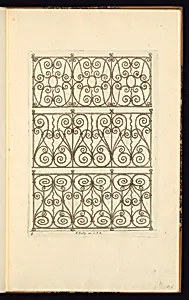
Wrought Iron Grille Designs
Classification
Department
Smithsonian Collection
Museum
Smithsonian American Art Museum
Credit
Purchased for the Museum by the Advisory Council
Accession Number
1921-6-473-6
Rights
Public Domain
About this artwork
Research in Progress
Art Historical Context
Step into the opulent world of 17th-century France with *Wrought Iron Grille* by Antoine Pierretz jeune, a skilled French artisan active around 1660-70. Created circa 1665, this print intricate patterns intended for wrought iron grilles—those elegant, forged barriers that graced grand chateaus, churches, public buildings during the reign of Louis XIV. As a print, it served as a vital blueprint, allowing metalworkers across Europe to replicate sophisticated motifs with precision. In the Baroque era, wrought ironwork symbolized craftsmanship and royal splendor, blending functionality with artistic flourish. Pierretz's designs reflect this fusion, showcasing scrolling vines, floral elements, and geometric symmetries that echoed the era's dramatic architecture, from Versailles' early phases to Parisian facades. Though the exact print medium remains under study, such works were typically engraved or etched, making high-end designs accessible to workshops and fostering a shared visual language among artisans. Housed in the Smithsonian American Art Museum, acquired through the Advisory Council, this piece highlights the transatlantic appeal of European decorative arts. It invites us to appreciate the unsung heroes of design—printmakers like Pierretz—who turned raw iron into enduring masterpieces of form and fantasy. Research continues to uncover more about its creation, promising deeper insights into this golden age of ornament.