
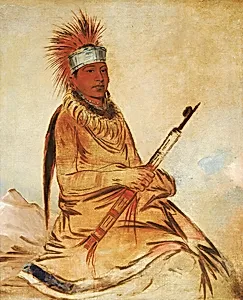
W'y-ee-yogh, Man of Sense, a Brave
1832
Medium
Painting
Classification
Painting
Department
Smithsonian Collection
Museum
Smithsonian American Art Museum
Credit
Smithsonian American Art Museum, Gift of Mrs. Joseph Harrison, Jr.
Accession Number
1985.66.259
Rights
Public Domain
Tags
About this artwork
George Catlin described Man of Sense as “another of this tribe [Iowa], much distinguished for his bravery and early warlike achievements. His head was dressed with a broad silver band passing around it, and decked out with the crest of horsehair.” Catlin further described the subject as having “a handsome pipe in his hand, and bears' claw necklace on his neck.” He probably painted this work at Fort Leavenworth (in today’s Kansas) in 1832. (Truettner, The Natural Man Observed, 1979)
Art Historical Context
**W'y-ee-yogh, Man of Sense, a** (1832) is a compelling portrait by George Catlin the pioneering 19th-century artist dedicated to documenting Native American life Painted during Catlin's travels among Midwestern tribes, this work an Iowa warrior renowned for his bravery and early war exploits. Likely created at Fort Leavenworth present-day Kansas—a key frontier military outpost—the painting reflects the tense cultural encounters of the 1830s, as Euro-American expansion pushed Indigenous peoples westward. Catlin vividly described his subject: a striking figure with a head adorned by a broad silver band and horsehair crest, holding a handsome pipe, and wearing a bears' claw necklace symbolizing his prowess as a hunter and fighter. Rendered in Catlin's signature realistic style, the oil painting emphasizes dignified individuality, countering stereotypes with authentic detail. As part of his vast "Indian Gallery," it holds immense historical value, preserving vanishing traditions amid rapid change. Today, housed in the Smithsonian American Art Museum, this portrait invites visitors to appreciate the Iowa people's resilience and Catlin's urgent mission to honor their humanity through art. (198 words)
About the Artist
George Catlin · 1796–1872
George Catlin (1796–1872), born in Wilkes-Barre, Pennsylvania, to Putnam Catlin and Polly Sutton—who had been captured by Native Americans during the 1778 Battle of Wyoming—initially pursued a legal career. Trained at Litchfield Law School, he was admitted to the bar in 1819 but abandoned law after two years to study art in Philadelphia in 1823. Self-taught as a portraitist, Catlin quickly gained ...