
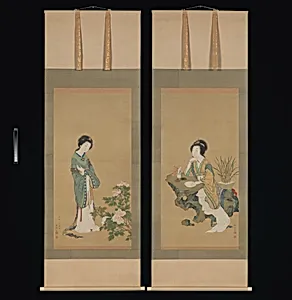
源琦筆 燕姞・楊貴妃図|Yanji with Orchids and Yang Guifei with Peonies
1785
Medium
Pair of hanging scrolls; ink and color on silk
Dimensions
Image (a): 43 3/16 × 21 15/16 in. (109.7 × 55.8 cm) Overall with mounting (a): 78 7/8 × 27 1/16 in. (200.3 × 68.8 cm) Overall with knobs (a): 78 7/8 × 29 5/16 in. (200.3 × 74.4 cm) Image (b): 43 3/16 × 21 15/16 in. (109.7 × 55.7 cm) Overall with mounting (b): 78 7/8 × 27 1/8 in. (200.3 × 68.9 cm) Overall with knobs (b): 78 7/8 × 29 5/16 in. (200.3 × 74.5 cm)
Classification
Paintings
Culture & Period
Japan · Edo period (1615–1868)
Department
Asian Art
Museum
Metropolitan Museum of Art, New York, NY
Credit
Mary Griggs Burke Collection, Gift of the Mary and Jackson Burke Foundation, 2015
Accession Number
2015.300.202a, b
Rights
Public Domain
Tags
Art Historical Context
This exquisite pair of hanging scrolls, created by the Japanese artist Genki (Komai Ki) in 1785 during the Edo period (161–1868), captures timeless beauty through ink and color on silk.itled *Yanji with Orch and Yang Guifei with Peonies*, the works depict two legendary women gracefully paired with symbolic flowers: Yanji amid delicate orchids and the iconic Tang dynasty consort Yang Guifei surrounded by lush peonies. Measuring about 43 by 22 inches each in image size, these scrolls were designed for display in a tokonoma alcove, transforming domestic spaces into poetic realms. In Edo Japan, such bijin-ga (pictures of beautiful women) celebrated feminine elegance while drawing on Chinese literary traditions. Yang Guifei, famed for her allure in poetry and drama, embodies opulent sensuality with peonies symbolizing wealth and romance. Orchids evoke purity and refinement for Yanji, blending floral symbolism with human grace. Genki's refined brushwork highlights the medium's luminosity on silk, allowing vibrant colors to shimmer. Part of the Metropolitan Museum of Art's Mary Griggs Burke Collection, these scrolls reflect the period's cultural flourishing, where art bridged Japanese and Chinese aesthetics for elite patrons. A captivating glimpse into 18th-century refinement! (198 words)
About the Artist
Genki (Komai Ki) · 1747–1797
**Genki (Komai Ki, also known as Komai Genki or 源琦)** was a Japanese painter active during the middle Edo period, born on June 12, 1747, in Kyoto and who died on August 8, 1797 (or September 27 according to some records), at the age of fifty. He is recognized as one of the leading figures in the Maruyama-Shijō school, a tradition that blended naturalistic observation with elegant decorative qualit...