
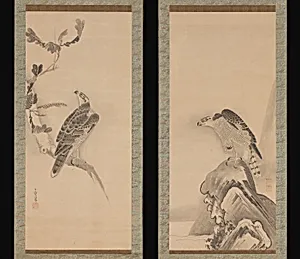
曽我二直庵筆 鷹図|Hawks
mid-17th century
Medium
Pair of hanging scrolls; ink on paper
Dimensions
Image: 49 15/16 × 22 3/8 in. (126.8 × 56.8 cm) Overall with mounting: 81 5/16 × 27 1/16 in. (206.5 × 68.7 cm) Overall with knobs: 81 5/16 × 29 3/16 in. (206.5 × 74.1 cm)
Classification
Paintings
Culture & Period
Japan · Edo period (1615–1868)
Department
Asian Art
Museum
Metropolitan Museum of Art, New York, NY
Credit
Mary and Cheney Cowles Collection, Gift of Mary and Cheney Cowles, 2018
Accession Number
2018.853.15a, b
Rights
Public Domain
Tags
Art Historical Context
Soga Nichokuan's *Hawks*, a pair mid-17th-century hanging in ink on paper, captures the majestic intensity of these birds of prey during Japan's Edo period (1615–1868). This era of relative peace under the Tokugawa shogunate a vibrant arts scene, where painters like Nichokuan blended Japanese traditions with Chinese literati influences. Adopting the pseudonym "S Nichokuan" to evoke the bold, expressive Soga school of the Muromachi period, he specialized in bird-and-flower subjects, using dynamic ink washes to convey life and movement. Rendered in sumi-e (ink painting) on large scrolls—each image measuring nearly 50 by 22 inches—these works showcase Nichokuan's mastery of minimalist brushwork. The hawks' piercing gazes and tensed feathers emerge through varying ink densities, from wet, flowing blacks to dry, textured strokes, embodying the Zen-inspired philosophy of capturing essence over realism. Hanging scrolls like these were prized for tokonoma alcove displays, unrolled for special occasions to inspire contemplation. In Japanese culture, hawks symbolized nobility, vigilance, and martial prowess, resonating with samurai ideals. This pair, now in the Metropolitan Museum of Art's Mary and Cheney Cowles Collection, highlights the cross-cultural exchange that enriched Edo art, inviting viewers to appreciate the timeless power of a single feather's curve.