
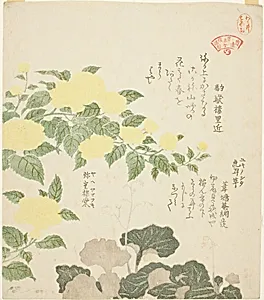
Yellow Roses (Yae yamabuki) and Creeping Saxifrages (Yukinoshita), from the series "Collection of Plants for the Kasumi Poetry Circle (Kasumi-ren somoku awase)"
1810s
Medium
Color woodblock print; shikishiban, surimono
Dimensions
21 × 18.2 cm (8 5/16 × 7 3/16 in.)
Classification
woodblock print
Department
Arts of Asia
Museum
Art Institute of Chicago
Accession Number
81380
Rights
Public Domain
Art Historical Context
In the early 19th century, during Japan's Edo period, Kubo Shunman crafted this exquisite *shikishiban surimono*—a square-format color woodblock print designed for private circulation. Titled *Yellow Roses (Yae yamabuki) and Creeping Saxifrages (Yukinoshita)*, it belongs to the series *Collection of Plants for the Kasumi Poetry Circle (Kasumi-ren somoku awase)*, created around the 1810s. Measuring just 21 × 18.2 cm, its intimate size suited personal appreciation, often as New Year's greetings or poetry keepsakes among elite circles. Surimono like this were luxurious commissions, featuring vibrant colors, fine carving, and subtle embossing achieved through meticulous woodblock techniques. Shunman, a master of the ukiyo-e tradition, excelled in capturing nature's delicate beauty, here rendering the golden double-petaled yamabuki (kerria roses, symbols of spring vibrancy in Japanese poetry) alongside the low-growing yukinoshita (saxifrage, evoking misty mountain slopes). Produced for the Kasumi-ren poetry group, the print likely paired these plants with evocative verses, blending botany and haiku in a cultural pastime that celebrated seasonal impermanence (*mono no aware*). Housed in the Art Institute of Chicago's Arts of Asia collection, this work highlights surimono's role in fostering artistic patronage outside commercial markets, preserving Shunman's legacy in poetic nature prints amid Japan's flourishing print culture.
About the Artist
Kubo Shunman · 1757–1820
Japanese, 1757–1820