
Medium
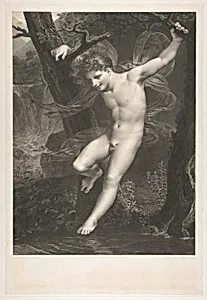
Stipple engraving with line engraving and etching; third state of four
Dimensions
image: 16 7/16 x 12 5/16 in. (41.7 x 31.3 cm) sheet: 21 15/16 x 15 15/16 in. (55.8 x 40.5 cm)
Classification
Prints
Department
Drawings and Prints
Museum
Metropolitan Museum of Art, New York, NY
Credit
Harris Brisbane Dick Fund, 1946
Accession Number
46.140.20
Rights
Public Domain
Tags
Art Historical Context
Behold *Zephyr*, a captivating 1864 stipple engraving with line engraving etching, the third state of four, after designs by the esteemed French Romantic artist Pierre-Paul Prud'hon (1758–1823) and executed by engraver Jean Nicolas Laug. This print from the Metropolitan Museum of Art Drawings and Prints department depicts the mythological west wind god Zephyr as a graceful male nude, embodying the classical ideal of youthful beauty and gentle breezes from Greek lore. Measuring 16 7/16 x 12 5/16 inches in its image area, it captures Prud'hon's signature sensual, ethereal style, blending Neoclassicism's precision with Romantic softness. The medium shines here: stipple engraving's dotted technique, combined with line work and etching, produces velvety tones and subtle gradations ideal for rendering Zephyr's flowing hair, diaphanous drapery, and luminous skin. Posthumously produced decades after Prud'hon's death, it reflects 19th-century printmaking's role in democratizing high art, allowing wider audiences to own refined reproductions of mythological subjects. Acquired via the Harris Brisbane Dick Fund in 1946, this work highlights the enduring allure of the male nude in Western art, evoking themes of nature's harmony and human divinity. A testament to technical mastery and timeless elegance, *Zephyr* invites visitors to ponder the whisper of winds through history.
About the Artist
Pierre Paul Prud'hon|Jean Nicolas Laugier · 1758–1823
Pierre Paul Prud'hon (1758–1823) was a French painter and draughtsman whose dreamy, sensuous art occupied a singular position between the Neoclassicism and Romanticism that competed for dominance in French painting around 1800. Born in Cluny in Burgundy, he received his early artistic training at the Dijon Academy before winning the Prix de Rome of the Estates of Burgundy, which allowed him to spe...