
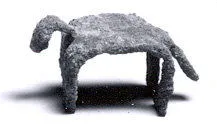
Zoomorphic Figure
Unknown Artist
9th–17th century
Medium
Copper alloy
Dimensions
H. 1/2 × W. 3/8 × L. 3/4 in. (1.3 × 1 × 1.9 cm)
Classification
Metal-Ornaments
Culture
Mali
Department
Arts of Africa, Oceania, and the Americas
Museum
Metropolitan Museum of Art, New York, NY
Credit
Gift of Mr. and Mrs. Arnold Syrop, 1987
Accession Number
1987.454.13
Rights
Public Domain
Tags
Art Historical Context
This delicate zoomorphic figure, crafted from copper alloy, hails from the region of Mali and dates to between the 9th and 17th centuries—a vast span encompassing the rise and flourishing of powerful West African kingdoms like the Mali Empire. Measuring just half an inch tall, this tiny ornament (H. 1/2 × W. 3/8 × L. 3/4 in.) exemplifies the metalworking skills of ancient Malian artisans, who likely employed lost-wax casting techniques to intricate, animal-inspired forms. Such small-scale works were portable treasures, possibly worn as pendants, amulets, or earrings, blending everyday adornment with deeper cultural symbolism. In Malian culture, zoomorphic figures—depicting animals whose exact form remains tantalizingly abstract here—often embodied spiritual protection, ancestral power, or connections to the natural world. Copper alloys, prized for their durability and luster, were traded across Saharan routes, linking Mali's gold-rich heartland to North African and Mediterranean influences. This piece, now in the Metropolitan Museum of Art's Department of Arts of Africa, Oceania, and the Americas (gift of Mr. and Mrs. Arnold Syrop, 1987), offers a window into a sophisticated society where metallurgy fueled art, trade, and identity. Its survival speaks to the resilience of these artifacts, reminding us how miniature masterpieces carried profound meaning in daily life. Visitors, imagine pinning this to your own attire—what stories might it whisper?