
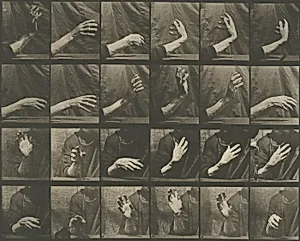
Animal Locomotion, Plate 535
Medium
Collotype, from "Animal Locomotion"
Dimensions
Image: 24 × 30.1 cm (9 1/2 × 11 7/8 in.); Paper: 34.4 × 49.6 cm (13 9/16 × 19 9/16 in.); Mount: 48.7 × 61.3 cm (19 3/16 × 24 3/16 in.)
Classification
photograph
Department
Photography and Media
Museum
Art Institute of Chicago
Accession Number
212168
Rights
Public Domain
About this artwork
In 1878 Eadweard Muybridge made headlines by successfully photographing a horse in motion. Through pioneering experiments with faster shutter speeds and a sequentially triggered line of cameras, Muybridge was able to freeze and record motion at speeds normally invisible to the human eye—discoveries that had lasting implications not only for scientific research but also for painting, photography, and film. Muybridge conducted a massive project of recording motion at the University of Pennsylvania...
Art Historical Context
Step into the revolutionary world of Eadwe Muybridge's *Animal Locomotion, Plate535* (1887), a stunning collotype print from his monumental 11-volume series of the same name. Housed in the Art Institute of Chicago's and Media department, this 24 × 30.1 cm image captures essence of movement through sequential photography—a technique Muybridge pioneered in the late 19th century. Originally sparked by a bet from railroad magnate Leland Stanford about whether a trotting horse ever lifts all four hooves off the ground, Muybridge's work shattered long-held artistic illusions of motion. Using a battery of up to 24 cameras triggered by electro-mechanical shutters, Muybridge froze split-second instants, revealing the true mechanics of animal and human locomotion. Plate 535, like others in the series, exemplifies this chronophotographic method, blending scientific precision with artistic vision. The collotype printing process ensured exquisite detail in reproductions, making these studies accessible to artists, scientists, and the public. This plate's legacy endures as a bridge between photography and cinema, influencing early filmmakers like the Lumière brothers and modern artists exploring motion. Muybridge's innovation not only transformed how we visualize movement but also invited viewers to marvel at the poetry hidden in everyday gaits—proving art and science can dance together. (198 words)
About the Artist
Eadweard Muybridge · 1830–1904
Eadweard Muybridge (1830-1904) was an English-American photographer who revolutionized the understanding of motion through his pioneering chronophotographic studies. Born Edward James Muggeridge in Kingston upon Thames, England, he emigrated to America and became famous first for his dramatic landscape photographs of Yosemite Valley, then for his groundbreaking motion studies that proved horses li...