
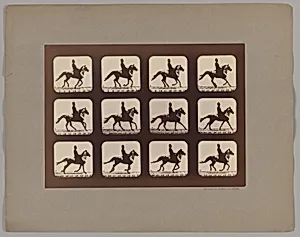
Attitudes of Animals in Motion
1879, printed 1881
Medium
Albumen silver print
Dimensions
Image: 6 5/16 × 9 15/16 in. (16 × 25.3 cm) Mount: 8 13/16 × 12 5/8 in. (22.4 × 32 cm)
Classification
Photographs
Department
Photographs
Museum
Metropolitan Museum of Art, New York, NY
Credit
Gift of Joyce F. Menschel, 2015
Accession Number
2015.778.33
Rights
Public Domain
Tags
Art Historical Context
Eadweard Muybridge’s “Attitudes of Animals in Motion” captures the pioneering spirit of late-nineteenth-century photography. Created in 1879 and printed in 1881, this albumen silver print belongs to Muybridge’s groundbreaking series that froze animals in sequential stages of movement. Working at a time when the camera was still a relatively new tool, Muybridge used multiple cameras triggered in rapid succession to reveal what the naked eye could not see—most famously, the moment when a galloping horse lifts all four hooves off the ground. The work sits at the intersection of art and science. By presenting horses in crisp, successive poses across a single frame, Muybridge challenged long-standing artistic conventions of depicting motion and helped lay the foundation for the motion-picture industry. His methodical approach transformed photography from a static medium into one capable of dissecting time itself. As an albumen silver print, the image carries the delicate tonal range and fine detail characteristic of the era’s most popular photographic process. Now part of the Metropolitan Museum of Art’s collection, this modest yet revolutionary sheet continues to invite viewers to reconsider how we perceive the natural world in motion.
About the Artist
Eadweard Muybridge · 1830–1904
Eadweard Muybridge (1830-1904) was an English-American photographer who revolutionized the understanding of motion through his pioneering chronophotographic studies. Born Edward James Muggeridge in Kingston upon Thames, England, he emigrated to America and became famous first for his dramatic landscape photographs of Yosemite Valley, then for his groundbreaking motion studies that proved horses li...