
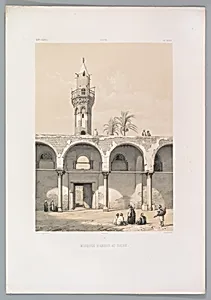
4. Mosquée d’Amrou, au Kaire
Medium
Lithograph
Dimensions
Sheet: 22 3/8 × 15 5/8 in. (56.9 × 39.7 cm)
Classification
Prints
Department
Photographs
Museum
Metropolitan Museum of Art, New York, NY
Credit
Joyce F. Menschel Photography Library Fund, 2017
Accession Number
2017.66.1
Rights
Public Domain
Art Historical Context
Joseph-Philibert Girault de Prangey, a pioneering French photographer and draftsman, created this lithograph in 1843 during his extensive travels through the Middle East. Titled *Mosquée d’Amrou, au Kaire*, the work captures the ancient Mosque of Amr ibn al-As in Cairo, one of Egypt’s earliest Islamic monuments. As part of a larger series documenting architecture and landscapes, it reflects the 19th-century fascination with Orientalist subjects and the desire to record distant cultures through emerging visual technologies. Printed as a lithograph on a substantial sheet measuring roughly 22 by 16 inches, the image likely derives from Girault de Prangey’s own daguerreotypes—the earliest practical form of photography. This choice of medium allowed fine architectural details to reach a broader European audience at a time when photography itself remained rare and difficult to reproduce. Today held in the Metropolitan Museum’s Department of Photographs, the print bridges the worlds of early photography and traditional printmaking, offering viewers a window into both the historic site and the birth of photographic documentation.
About the Artist
Joseph-Philibert Girault de Prangey · 1804–1892
Joseph-Philibert Girault de Prangey (1804–1892), born in Langres, France, as the sole surviving child of Claude Joseph Girault and Barbe Philiberte Rosine Piétrequin, inherited the lordships of Genevrières and Prangey, adopting his full surname in 1825. After studies at Langres college and in Paris, where he earned baccalauréats in letters (1826) and law (1828), he pursued artistic training under ...