
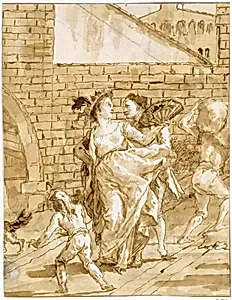
A Flirtation
ca. 1797
Medium
Pen and brown ink, brown wash, over black chalk
Dimensions
11 1/4 x 8 3/4 in. (28.6 x 22.2 cm)
Classification
Drawings
Department
Robert Lehman Collection
Museum
Metropolitan Museum of Art, New York, NY
Credit
Robert Lehman Collection, 1975
Accession Number
1975.1.513
Rights
Public Domain
Tags
Art Historical Context
Giovanni Domenico Tiepolo's *A Flirtation* (ca. 1797) captures a moment of playful courtship between a man and a woman, with the artist's signature Rococo charm. The son of the illustrious Venetian master Giovanni Battista Tiepolo Domenico carried forward his father's elegant, lighthearted style into the late 18th century, blendingy with refined observation. This intimate drawing, now in the Robert Lehman Collection at The Metropolitan Museum of Art, the vibrant social life of Venice during a time of cultural transition, just before the city's fall to Napoleon. Executed in pen and brown ink with brown wash over black chalk, the work exemplifies Tiepolo's masterful draftsmanship. The underdrawing in black chalk provides a fluid structural foundation, while the ink lines add precise, expressive contours, and the wash introduces subtle tonal modeling and atmosphere. Such mixed-media techniques were prized in 18th-century Italy for their versatility, allowing artists like Tiepolo to create luminous, standalone sheets that rival finished paintings in emotional depth. At 11¼ × 8¾ inches, this gem offers a window into Domenico's late oeuvre, showcasing his affinity for genre scenes that celebrate human connection. Part of the esteemed Lehman Collection since 1975, it highlights the enduring appeal of Venetian draftsmanship, inviting visitors to savor its flirtatious spirit and technical finesse.
About the Artist
Giovanni Domenico Tiepolo · 1727–1804
Giovanni Domenico Tiepolo (1727-1804) was a Venetian painter, printmaker, and draftsman whose career spanned the twilight of the Rococo era. Born on August 30, 1727, in Venice as the eldest son of the celebrated Giovanni Battista Tiepolo, he worked both in his father's shadow and as a significant independent artist who developed a distinctly earthbound and humanistic vision. Domenico's importance...