
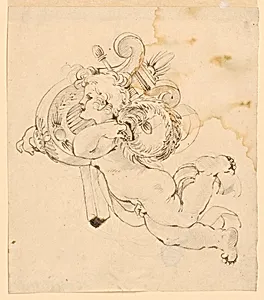
A Flying Putto Supporting a Lyre with His Right Shoulder, and a Wreath with His Left One
Classification
Drawing
Department
Smithsonian Collection
Museum
Smithsonian American Art Museum
Credit
Museum purchase through gift of various donors and from Eleanor G. Hewitt Fund
Accession Number
1938-88-8064
Rights
Public Domain
About this artwork
Research in Progress
Art Historical Context
In the Smithsonian American Art Museum's collection *A Flying Putto Supporting Lyre with His Right, and a Wreath with His Left One* a delicate drawing by Italian artist Fortunatoanti (1787–1863). between 1820 and 1850, this work captures a playful yet classical motif: a winged putto—a chubby, cherubic child figure rooted in Renaissance and Baroque traditions—balancing a lyre on one shoulder and a victory wreath on the other.anti, a sculptor from Carrara known for his neoclassical designs, likely produced this as a preparatory study for larger marble works, evoking the grandeur of ancient mythology. Putti like this one symbolize innocence, love, and the arts, with the lyre nodding to Apollo, god of music and poetry, and the wreath signifying triumph or honor. During Italy's early 19th century, amid Romanticism's rise, artists like Duranti revived classical themes to bridge antiquity and modernity, often for decorative sculptures in palaces or public spaces. Though the exact medium remains unknown, such drawings typically employed ink, chalk, or graphite on paper, showcasing fluid lines and dynamic poses that highlight the artist's skill in capturing movement. Acquired through museum purchase with donor gifts, this piece offers a glimpse into Duranti's workshop practice and the enduring appeal of mythological whimsy in European art. It's a charming reminder of how 19th-century draughtsmen kept alive the spirit of antiquity for new audiences.