
Two Flying Putti
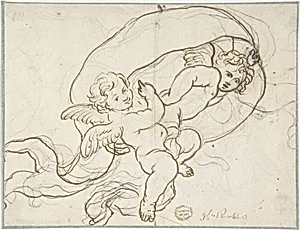
Medium
Pen and brown ink over black chalk on cream paper
Dimensions
5-5/8 x 7-5/16 in. (14.3 x 18.6 cm)
Classification
Drawings
Department
Drawings and Prints
Museum
Metropolitan Museum of Art, New York, NY
Credit
Gift of Cephas G. Thompson, 1887
Accession Number
87.12.117
Rights
Public Domain
Tags
Art Historical Context
Behold the whimsical *Two Flying Putti*, 17th-century drawing by an anonymous Italian artist from the-Bolognese school, now treasured in the Metropolitan Museum of Art's Department of Drawings and Prints. cherubic figures—playful, winged infants symbolizing love and joy—frolic mid-air, capturing the exuberant spirit of Baroque art. Common in Italian decorative schemes for churches, palaces, and frescoes, putti like these brought divine whimsy to earthly spaces, echoing the era's dramatic religious and theatrical fervor. Crafted on cream paper with black chalk underdrawing refined by precise pen and brown ink lines, this intimate sheet (just 5-5/8 x 7-5/16 inches) exemplifies preparatory techniques of the time. Artists used chalk for fluid sketches and ink for crisp definition, often as studies for larger sculptures or paintings by masters like Bernini or the Carracci family, whose Bolognese influence emphasized naturalism amid Roman grandeur. A gift to the Met in 1887 from Cephas G. Thompson, this delicate work invites us to appreciate the artistry behind the spectacle—where every swirling contour hints at motion and mischief in Italy's Golden Age of drawing.