
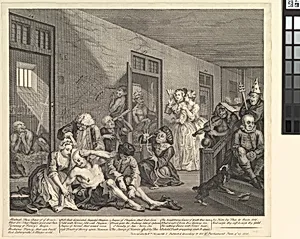
A Rake's Progress, Plate 8
June 25, 1735
Medium
Engraving; second state of three
Dimensions
sheet: 13 15/16 x 15 15/16 in. (35.4 x 40.5 cm)
Classification
Prints
Department
Drawings and Prints
Museum
Metropolitan Museum of Art, New York, NY
Credit
Harris Brisbane Dick Fund, 1932
Accession Number
32.35(35)
Rights
Public Domain
Tags
Art Historical Context
**A Rake's Progress, 8** (1735) is the poignant finale to William Hogarth's iconic of eight engravings, a satirical tale tracing the reckless descent of Tom Rake from inheritance to ruin. Created in collaboration with Dr. John Hley, who contributed accompanying verses, this second-state impression captures Hogarth's mastery of narrative printmaking. Published on June 25, 1735, it reflects the vibrant yet cautionary spirit of 18th-century British Rococo satire, warning against the perils of vice, folly, and fleeting pleasures. In this climactic scene set in London's infamous Bedlam asylum, men and women gather amid musical instruments like violins, evoking a chaotic blend of entertainment and despair. Hogarth's intricate engraving technique—layered lines for texture, dramatic contrasts, and symbolic details—brings the bustling composition to life on a grand sheet (13 15/16 x 15 15/16 in.). The medium's affordability allowed widespread dissemination, making the series a cultural phenomenon that critiqued societal excesses. Housed in the Metropolitan Museum of Art's Drawings and Prints department (Harris Brisbane Dick Fund, 1932), this print exemplifies Hogarth's innovative storytelling, influencing generations of artists and underscoring the era's fascination with moral reform through art. A stark reminder: fortune's wheel turns swiftly.
About the Artist
William Hogarth|Dr. John Hoadley · 1697–1764
William Hogarth (1697-1764) was an English painter, printmaker, and pictorial satirist who became the first great English-born artist to attract admiration abroad. Born into poverty in London, the son of a failed schoolmaster who was imprisoned for debt, Hogarth's early experiences with the harsh realities of 18th-century urban life profoundly shaped his artistic vision. After apprenticing with si...