
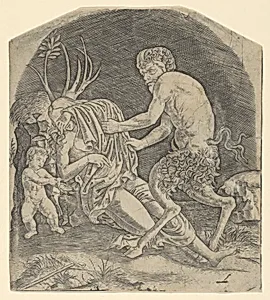
A satyr about to remove drapery covering a Nymph
ca. 1510–20
Medium
Engraving
Dimensions
Sheet: 5 11/16 × 5 1/16 in. (14.5 × 12.9 cm)
Classification
Prints
Department
Drawings and Prints
Museum
Metropolitan Museum of Art, New York, NY
Credit
The Elisha Whittelsey Collection, The Elisha Whittelsey Fund, 1948
Accession Number
48.176.3
Rights
Public Domain
Tags
Art Historical Context
In the early 16th century, engraver Marcantonioondi captured a playful yet charged mythological moment in *A Satyr about to Remove Drapery Covering a N* (ca. 1510–20). This intimate engraving, measuring just 5 11/16 × 5 1/16 inches, depicts a lecherous satyr—half-man, half-goat from classical lore—gingerly lifting the veil from a graceful nymph, surrounded by frolicsome infants. These figures evoke the vibrant world of ancient Greek and Roman myths, revived during the High Renaissance as artists celebrated the human form and nature's sensual joys. Raimondi's mastery of engraving, a revolutionary printmaking technique using a burin to incise intricate lines into copper plates, allowed for precise shading and texture on a modest scale. As one of the era's premier reproductive engravers, he popularized designs by masters like Raphael, making high art accessible beyond elite patrons. This work exemplifies how engravings democratized imagery, circulating erotic and whimsical classical themes across Europe. Housed in the Metropolitan Museum of Art's Drawings and Prints department as part of The Elisha Whittelsey Collection, the piece highlights the cultural allure of satyrs and nymphs—symbols of untamed desire and ethereal beauty. It's a window into Renaissance fascination with antiquity, blending humor, sensuality, and technical virtuosity for collectors today.
About the Artist
Marcantonio Raimondi · 1475–1534
Marcantonio Raimondi (c. 1480–1534), born near Bologna, Italy, emerged as one of the Renaissance's premier engravers, revolutionizing printmaking through his mastery of reproductive techniques. He trained in the workshop of the goldsmith, painter, and niellist Francesco Francia, whose influence is evident in his early engravings, such as the goldsmith-like shading in *Pyramus and Thisbe* (1505), h...