
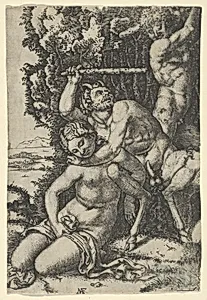
A satyr fighting for a nymph
Medium
Engraving
Dimensions
Sheet: 4 5/8 × 3 3/16 in. (11.8 × 8.1 cm)
Classification
Prints
Department
Drawings and Prints
Museum
Metropolitan Museum of Art, New York, NY
Credit
Anonymous Gift, 1929
Accession Number
29.44.14
Rights
Public Domain
Tags
Art Historical Context
In the bustling world of Renaissance printmaking, *A Satyr Fighting for a Nymph* (ca. 1510–40) captures a lively mythological skirmish through the masterful engraving techniques of Marcantonio Raimondi, possibly after a design by Francesco Francia. This intimate sheet, measuring just 4 5/8 × 3 3/16 inches, exemplifies the era's fascination with classical antiquity, where satyrs—half-human, half-goat creatures symbolizing untamed desire—pursue ethereal nymphs amid tangled trees. Such scenes revived Greco-Roman myths, blending eroticism with naturalism to appeal to scholarly collectors. Engraving, a precise intaglio method where lines are incised into a metal plate for inked impressions, allowed artists like Raimondi to reproduce intricate details with remarkable fidelity. This innovation democratized high art, spreading Bolognese and Roman styles across Europe. The work's fluid male nudes and dynamic poses highlight Renaissance ideals of the body, echoing masters like Raphael, whom Raimondi often collaborated with. Housed in the Metropolitan Museum of Art's Drawings and Prints department (Anonymous Gift, 1929), this anonymous-attributed gem invites visitors to ponder the playful yet primal tensions of myth, preserved in a medium that bridged painting and mass appeal.
About the Artist
Anonymous|Francesco Francia|Marcantonio Raimondi
In the vast tapestry of art history, "Anonymous" stands not as a singular individual but as a collective designation for countless unidentified creators whose works have endured across millennia. These artists, spanning prehistoric cave painters to medieval illuminators and folk craftsmen, produced the foundational layers of human visual culture. Prior to the Renaissance, when individual fame emer...