
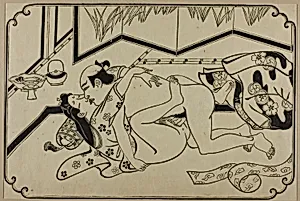
A sheet from a shunga album
1680s
Medium
Woodblock print; sumizuri-e
Classification
woodblock print
Department
Arts of Asia
Museum
Art Institute of Chicago
Accession Number
130212
Rights
Public Domain
Art Historical Context
Hishikawa Moronobu, a foundational figure in the ukiyo-e tradition, created this sheet as part of a shunga album in the 1680s. Active during Japan’s Edo period, Moronobu helped popularize woodblock prints depicting the “floating world” of urban life, theater, and pleasure quarters. His work often blended everyday scenes with graceful, expressive figures, laying the groundwork for later masters of the genre. This print belongs to the sumizuri-e technique, an early form of woodblock printing that relies on black ink alone, sometimes enhanced by subtle hand-coloring. Shunga—literally “spring pictures”—were erotic albums enjoyed across social classes in Japan, valued not only for their sensual content but also as guides to love and humor. Produced in small, intimate formats, they reflect a cultural openness to such imagery that contrasts with many Western traditions of the same era. Today, sheets like this one offer visitors a window into 17th-century Japanese aesthetics, where line, composition, and suggestion conveyed both beauty and intimacy with remarkable economy.
About the Artist
Hishikawa Moronobu
Hishikawa Moronobu (1618–1694) holds an unassailable position in Japanese art history as the founder of ukiyo-e, the 'pictures of the floating world' that would become Japan's most internationally recognized art form. Born in the provincial town of Yasuda during the early Edo period, Moronobu transformed woodblock printing from a purely utilitarian craft into an independent artistic medium, establ...