
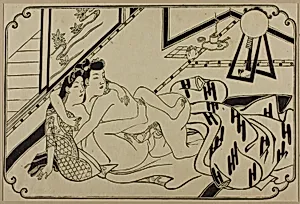
A sheet from a shunga album
1680s
Medium
Woodblock print; sumizuri-e
Classification
woodblock print
Department
Arts of Asia
Museum
Art Institute of Chicago
Accession Number
130217
Rights
Public Domain
Art Historical Context
This sheet from a sh album by Hishikawaonobu captures the spirit of early ukiyo-e in late 17th-century Japan. Created in the 1680s during the Edo period, Moronobu is celebrated as a founder of the ukiyo-e movement, which celebrated the fleeting pleasures of urban life. Shunga—literally “spring pictures”—formed a popular genre of erotic art that appeared in handscrolls and albums, often blending sensuality with humor, poetry, and everyday scenes to appeal to a growing merchant-class audience. Executed as a woodblock print in sumizuri-e, the work relies on bold black ink lines on paper, a technique that highlights Moronobu’s masterful draftsmanship before the advent of color printing. These monochromatic prints allowed for intricate details and dynamic compositions that were widely circulated, making art more accessible beyond elite circles. As part of an album, this sheet likely formed one page in a sequence exploring intimate moments, reflecting the cultural openness toward such themes in Tokugawa Japan. Housed in the Art Institute of Chicago’s Arts of Asia collection, the print offers modern viewers a glimpse into Moronobu’s pioneering role in transforming woodblock printing into a major artistic medium. Its survival underscores shunga’s historical significance as both entertainment and a reflection of societal attitudes toward love and the human form.
About the Artist
Hishikawa Moronobu
Hishikawa Moronobu (1618–1694) holds an unassailable position in Japanese art history as the founder of ukiyo-e, the 'pictures of the floating world' that would become Japan's most internationally recognized art form. Born in the provincial town of Yasuda during the early Edo period, Moronobu transformed woodblock printing from a purely utilitarian craft into an independent artistic medium, establ...