
Abraham and Isaac
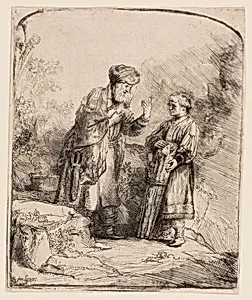
Medium
Etching and drypoint on white laid paper
Dimensions
Image/plate: 15.6 × 12.8 cm (6 3/16 × 5 1/16 in.); Sheet: 15.9 × 13.1 cm (6 5/16 × 5 3/16 in.)
Classification
etching
Department
Prints and Drawings
Museum
Art Institute of Chicago
Accession Number
13084
Rights
Public Domain
Art Historical Context
Rembrandt van Rijn's *Abraham and Isaac* (1645) is a masterful etching and drypoint that captures the tense biblical moment from Genesis 22, where Abraham prepares to sacrifice his son Isaac at God's command, only to be halted by divine intervention. Created during Rembrandt's Amsterdam period, this print reflects the Dutch Golden Age's fascination with dramatic religious narratives, blending profound emotion with moral introspection. Rembrandt, a Baroque genius known for his chiaroscuro—masterful play of light and shadow—infuses the scene with raw humanity, highlighting Abraham's anguish and Isaac's vulnerability. The medium of etching and drypoint on white laid paper is key to its brilliance. Etching allowed precise lines via acid-bitten plates, while drypoint's direct burr-scratching created velvety textures and tonal depth, mimicking Rembrandt's oil paintings. At just 15.6 × 12.8 cm, this intimate work exemplifies his printmaking innovations, producing rich, painterly effects that rival larger canvases. Housed in the Art Institute of Chicago's Prints and Drawings department, it showcases Rembrandt's technical virtuosity—only about 100 impressions survive, making it a collector's treasure. This artwork not only underscores Rembrandt's status as the era's greatest printmaker but also invites viewers to ponder faith, obedience, and mercy, resonating across centuries in museum galleries.
About the Artist
Rembrandt van Rijn · 1606–1669
Rembrandt Harmenszoon van Rijn (1606–1669) stands as one of the greatest visual artists in the history of Western art and the most important Dutch painter of the 17th century. Born in Leiden to a prosperous miller's family, Rembrandt transformed painting through his revolutionary use of light and shadow, his psychological depth in portraiture, and his elevation of etching to a fine art. His approx...