
Adam
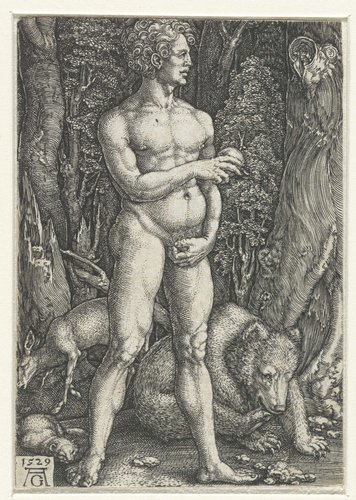
Medium
engraving
Dimensions
56; 80
Rights
Public Domain
About this artwork
datum
Art Historical Context
Behold Heinrich Aldegrever's enchanting engraving *Adam* (1529), a diminutive yet masterful work measuring just 80 mm high by 56 mm wide. Created during the Northern Renaissance, this piece captures the biblical figure in intricate detail, showcasing Aldegrever's as one of the "Little Masters"—a group of German artists renowned for their exquisitely refined small-scale prints. Aldegrever, a goldsmith-turned-engraver from Soest, Germany, drew inspiration from masters like Albrecht Dürer. Engraving, an intaglio technique involving incised metal plates inked and pressed onto paper, allowed for precise lines and textures ideal for portable, collectible art. In 1529, amid the Protestant Reformation, such images democratized religious iconography, making profound narratives accessible beyond grand altarpieces. This artwork reflects Renaissance humanism's fascination with the human form and Genesis stories, blending spiritual depth with technical virtuosity. A gem for collectors, *Adam* invites us to ponder humanity's origins through Aldegrever's enduring lens.
About the Artist
Heinrich Aldegrever · 1502–1561
Heinrich Aldegrever, born in 1502 in Paderborn, Westphalia, to parents Herman and Katherine Trippenmeker—a family of clog-makers known by the dialect name Trippenmecker—emerged as a multifaceted artist in the German Renaissance. His early training remains undocumented, though he likely apprenticed in a Soest goldsmith's workshop after relocating there around 1525, where he joined the painters' gui...