
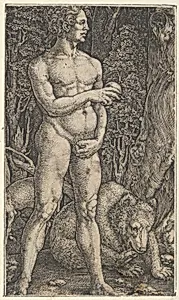
Adam with a Bear
Medium
Engraving
Dimensions
Sheet (trimmed): 3 1/16 × 1 13/16 in. (7.8 × 4.6 cm)
Classification
Prints
Department
Drawings and Prints
Museum
Metropolitan Museum of Art, New York, NY
Credit
Harris Brisbane Dick Fund, 1917
Accession Number
17.3.1377
Rights
Public Domain
Tags
Art Historical Context
In the heart of the Northern Renaissance, German engraver Heinrich Aldegver crafted *Adam with a Bear* in 1529, a delicate engraving measuring just 3 1/16 × 1 13/16 inches. Aldegrever, one of the "Little Masters" renowned for their virtuosic small-scale prints, belonged to a circle of Protestant artists in Westphalia who blended intricate detail with moral and biblical themes. This tiny work, now in the Metropolitan Museum of Art's Drawings and Prints collection, captures a serene moment from Genesis, where Adam names the animals in Eden—here spotlighting an unexpectedly gentle bear. Engravings like this were revolutionary for their time, using a burin to incise fine lines into a copper plate, allowing precise textures and shading in an intimate format. Aldegrever's mastery shines in the bear's fur and Adam's contemplative pose, evoking pre-Fall harmony between humanity and nature. Produced amid the Reformation's upheavals, such prints democratized religious imagery, making profound stories accessible beyond grand altarpieces. What makes this piece intriguing? Bears, symbols of wild strength in Renaissance lore, rarely steal the scene in Adam narratives—highlighting Aldegrever's fascination with the natural world. A testament to 16th-century ingenuity, it invites us to ponder innocence lost in a single, bear-sized glance.
About the Artist
Heinrich Aldegrever · 1502–1561
Heinrich Aldegrever, born in 1502 in Paderborn, Westphalia, to parents Herman and Katherine Trippenmeker—a family of clog-makers known by the dialect name Trippenmecker—emerged as a multifaceted artist in the German Renaissance. His early training remains undocumented, though he likely apprenticed in a Soest goldsmith's workshop after relocating there around 1525, where he joined the painters' gui...