
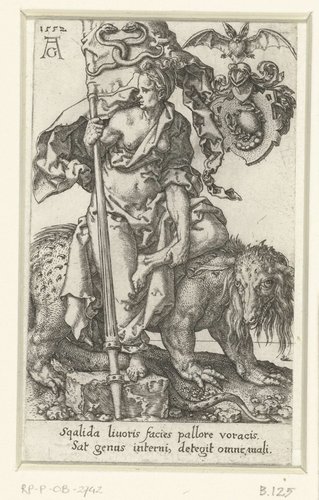
Afgunst
Medium
engraving
Dimensions
61; 102
Rights
Public Domain
About this artwork
number: ‘110’
Art Historical Context
**Afgunst (Envy)** Heinrich Aldegrever, a German engraver of the Northern Renaissance, created *Afgunst* in 1552. This small engraving, measuring just 102 × 61 mm, exemplifies the "Little Masters"—a group of 16th-century artists celebrated for their exquisite miniature works on copper plates. Aldegrever, active in Soest, blended Gothic precision with emerging Renaissance humanism, often depicting moral allegories that resonated in an era of religious upheaval and Reformation fervor. The title *Afgunst*, Dutch for "Envy," likely portrays this deadly sin as a personified figure, a common motif in Aldegrever's output of virtue-and-vice series. Cataloged as number '110,' it reflects the period's didactic art, urging viewers to contemplate human flaws through vivid symbolism. Engraving's technique—incising fine lines into metal, inking, and pressing onto paper—allowed Aldegrever to achieve remarkable detail and tonal depth in such a compact format, making these prints affordable and widely collectible. This piece highlights engraving's revolutionary role in democratizing art, bridging elite workshops and everyday audiences across Europe. Its enduring appeal lies in Aldegrever's technical virtuosity, inviting us to reflect on timeless vices in a glance.
About the Artist
Heinrich Aldegrever · 1502–1561
Heinrich Aldegrever, born in 1502 in Paderborn, Westphalia, to parents Herman and Katherine Trippenmeker—a family of clog-makers known by the dialect name Trippenmecker—emerged as a multifaceted artist in the German Renaissance. His early training remains undocumented, though he likely apprenticed in a Soest goldsmith's workshop after relocating there around 1525, where he joined the painters' gui...