
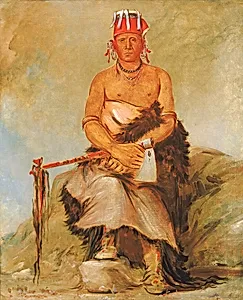
A'h-sha-la-cóots-ah, Mole in the Forehead, Chief of the Republican Pawnee
1832
Medium
Painting
Classification
Painting
Department
Smithsonian Collection
Museum
Smithsonian American Art Museum
Credit
Smithsonian American Art Museum, Gift of Mrs. Joseph Harrison, Jr.
Accession Number
1985.66.104
Rights
Public Domain
Tags
About this artwork
George Catlin probably painted these images of Pawnee chiefs and warriors at Fort Leavenworth (in today’s Kansas) in 1832. He later described the tribe as: “A very powerful and warlike nation, living on the river Platte, about one hundred miles from its junction with the Missouri; laying claim to, and exercising sway over, the whole country, from its mouth to the base of the Rocky Mountains. The present number of this tribe is ten or twelve thousand; about one half the number they had in 1832, w...
Art Historical Context
**A'h-sha-la-cÓots-ah, Mole in the Forehead, Chief of the Republican Pawnee** (1832) is a compelling portrait by George Catlin, the pioneering 19th-century artist dedicated to documenting Native American life. Painted at Fort Leavenworth in present-day Kansas, it captures the dignified likeness of a Pawnee chief, whose striking name reflects tribal naming traditions tied to physical features. Catlin, known for his realistic oil portraits, created this as part of his ambitious "Indian Gallery," aiming to preserve vanishing cultures before Western expansion altered them forever. The Pawnee, as Catlin described in his *Letters and Notes* (1841), were a powerful, warlike nation along the Platte River, claiming vast territories to the Rocky Mountains. In 1832, their population stood at around 20,000–24,000, but tragedy struck soon after when smallpox—introduced accidentally by fur traders and whiskey sellers—devastated them, killing over 10,000 in months. This portrait, now in the Smithsonian American Art Museum, offers a poignant glimpse into their world on the cusp of such loss, highlighting Catlin's role in ethnographic art. Through meticulous detail and empathetic gaze, Catlin's work underscores the cultural richness and resilience of the Pawnee, inviting us to reflect on history's human cost. (198 words)
About the Artist
George Catlin · 1796–1872
George Catlin (1796–1872), born in Wilkes-Barre, Pennsylvania, to Putnam Catlin and Polly Sutton—who had been captured by Native Americans during the 1778 Battle of Wyoming—initially pursued a legal career. Trained at Litchfield Law School, he was admitted to the bar in 1819 but abandoned law after two years to study art in Philadelphia in 1823. Self-taught as a portraitist, Catlin quickly gained ...