
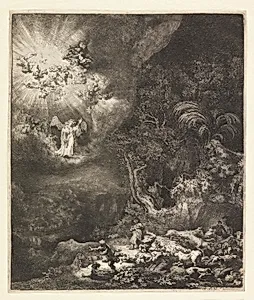
Annunciation to the Shepherds
Classification
figures
Department
Smithsonian Collection
Museum
Smithsonian American Art Museum
Credit
Gift of Leo Wallerstein
Accession Number
1950-131-146
Rights
Public Domain
About this artwork
Research in Progress
Art Historical Context
Rembrandt Harmensz van Rijn's *Annunciation to the Shepherd* (1634) captures a pivotal moment from the Gospel of Luke, where angels herald the birth of Christ to shepherds in the fields. Created during Rembrandt's early years in Amsterdam, amid the Dutch Golden Age, this work reflects the artist's burgeoning mastery of dramatic biblical narratives. At just 28, Rembrandt was already renowned for infusing religious scenes with profound human emotion, drawing from his Protestant context while evoking universal wonder. Rembrandt's Baroque style shines through in his innovative use of chiaroscuro—bold contrasts of light and shadow—that spotlight divine revelation amid rustic darkness. The classification as "figures" underscores his focus on expressive characters, likely rendered with his signature loose brushwork and psychological depth, making celestial messengers and awestruck shepherds feel intimately real. Though the medium remains under research, such works exemplify his versatility across etchings and oils. Housed in the Smithsonian American Art Museum as a gift from Leo Wallerstein, this piece invites visitors to ponder faith's quiet interruptions in everyday life. A testament to Rembrandt's enduring legacy, it bridges 17th-century spirituality with timeless artistry.