
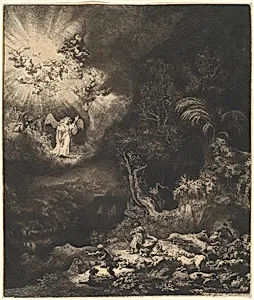
The Angel Appearing to the Shepherds
Medium
etching, burin and drypoint
Classification
Department
CG-E
Museum
National Gallery of Art, Washington, D.C.
Credit
Rosenwald Collection
Accession Number
1943.3.7094
Rights
Public Domain
Art Historical Context
In the hushed glow of a pastoral night, Rembrandt van Rijn's *The Angel Appearing the Shepherds* (4) captures a pivotal biblical moment from the Gospel of Luke: angel's divine announcement of Christ's birth to shepherds. Created early in Rembrandt's prolific career during the Dutch Golden Age, this exemplifies his mastery of Baroque drama, where light pierces the darkness to symbolize revelation and hope. The artist's empathetic portrayal of ordinary folk—startled yet reverent—reflects the era's Protestant emphasis on personal faith over grandeur. Rembrandt revolutionized printmaking with this etching, enhanced by burin (for fine lines) and drypoint (for velvety burrs that hold ink richly). These techniques allowed unprecedented tonal depth and texture, mimicking the chiaroscuro effects of his paintings. Only a few states of this plate survive, making impressions like this one from the National Gallery of Art's Rosenwald Collection rare treasures. Housed in the museum's prints department (CG-E), the work underscores Rembrandt's influence on etching as an expressive medium, bridging fine art and accessibility. Visitors are drawn to its intimate scale and luminous mystery, a testament to 17th-century innovation in capturing the sacred.
About the Artist
Rembrandt van Rijn · 1606–1669
Rembrandt Harmenszoon van Rijn (1606–1669) stands as one of the greatest visual artists in the history of Western art and the most important Dutch painter of the 17th century. Born in Leiden to a prosperous miller's family, Rembrandt transformed painting through his revolutionary use of light and shadow, his psychological depth in portraiture, and his elevation of etching to a fine art. His approx...