
The Angel Appearing to the Shepherds
Medium
Etching, engraving, and drypoint in black on ivory laid paper
Dimensions
Image/plate: 25.9 × 21.8 cm (10 1/4 × 8 5/8 in.); Sheet: 26.2 × 22 cm (10 3/8 × 8 11/16 in.)
Classification
etching
Department
Prints and Drawings
Museum
Art Institute of Chicago
Accession Number
29062
Rights
Public Domain
About this artwork
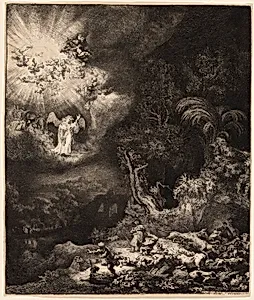
This nocturnal scene from the Gospel of Luke represents Rembrandt’s first attempt to render shadows in print with the same gravity and depth he achieved in oil paint. In the upper left, an angel stands before a glowing celestial vortex and announces the birth of Christ. At the center of the divine light is the dove of the Holy Spirit, defined by a few small marks. Terrified by the sudden blast in the night, herdsman and their beasts run amok. To depict the stunning collision between heaven and ...
Art Historical Context
In the glow of divine revelation, Rembrandt van Rijn *The Angel Appearing to the Shepherds*1634) captures a pivotal moment from the Gospel of Luke: an angel descending amid radiant light to announce Christ's birth to humble shepherds. Created during Rembrandt's early maturity in Amsterdam, this etching reflects the Dutch Golden Age's fascination with biblical narratives, blending spiritual drama with everyday humanity. At just 25.9 × 21.8 cm, its intimate scale invites close contemplation, much like a whispered secret shared in the night. Rembrandt, a Baroque master renowned for chiaroscuro—the interplay of light and shadow—elevated printmaking to painterly heights here. He combined etching for precise lines, engraving for depth, and drypoint for velvety burrs that mimic the texture of woolen cloaks and feathered wings. Printed on ivory laid paper, the work's rich blacks and luminous whites create a heavenly burst piercing the darkness, showcasing his innovative technique that influenced generations of printmakers. Housed in the Art Institute of Chicago's Prints and Drawings Department, this piece exemplifies Rembrandt's prolific output of over 300 etchings, prized for their emotional intensity and technical bravura. For visitors, it's a testament to how a simple sheet of paper can evoke the sublime, bridging 17th-century faith with timeless wonder.
About the Artist
Rembrandt van Rijn · 1606–1669
Rembrandt Harmenszoon van Rijn (1606–1669) stands as one of the greatest visual artists in the history of Western art and the most important Dutch painter of the 17th century. Born in Leiden to a prosperous miller's family, Rembrandt transformed painting through his revolutionary use of light and shadow, his psychological depth in portraiture, and his elevation of etching to a fine art. His approx...