
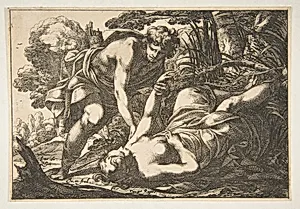
Apollo and Clytie
Medium
Etching; second state of two (Robert-Dumesnil)
Dimensions
sheet: 6 9/16 x 9 7/16 in. (16.6 x 24 cm)
Classification
Prints
Department
Drawings and Prints
Museum
Metropolitan Museum of Art, New York, NY
Credit
Purchase, The Elisha Whittelsey Collection, The Elisha Whittelsey Fund, 1953
Accession Number
53.638.11
Rights
Public Domain
Tags
Art Historical Context
This etching, titled *Apollo and Clytie*, captures a moment from classical mythology through the combined efforts of painter Laurent de La Hyre and engraver François de Poilly. Created in 1606 and measuring just over six by nine inches, print depicts the sun god Apollo alongside the nymph Clytie, with visual elements including arrows and female figures that evoke themes of divine pursuit and transformation. As a second state of two, it reflects the careful refinement typical of reproductive prints from this era. Etching allowed artists like Poilly to translate La Hyre’s designs into widely accessible images, playing a vital role in spreading knowledge of mythological stories and artistic styles across Europe during the early seventeenth century. La Hyre, working in the French Baroque tradition with its emphasis on clarity and classical ideals, contributed compositions that balanced dramatic narrative with elegant line work, while the medium itself offered fine detail and tonal subtlety suited to intimate viewing. Housed in the Metropolitan Museum of Art’s Department of Drawings and Prints, this work highlights how prints bridged painting and popular culture, inviting viewers to engage with ancient tales through affordable, portable art. Its acquisition through the Elisha Whittelsey Fund underscores its value as both a technical achievement and a window into the enduring appeal of Greco-Roman subjects.
About the Artist
Laurent de La Hyre|Francois de Poilly · 1606–1656
Laurent de La Hyre (1606–1656) was a French painter whose elegant, classical compositions placed him among the finest artists of the first generation of French Baroque painters working in Paris. Born into an artistic family — his father Étienne de La Hyre was also a painter — Laurent received his early training largely through independent study rather than formal apprenticeship under a single domi...