
Speculum Romanae Magnificentiae: Laocoon
16th century
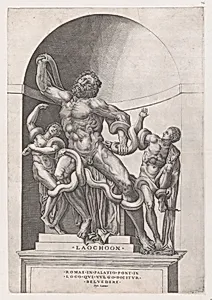
Medium
Engraving; second state of two (Robert-Dumesnil)
Dimensions
sheet: 17 1/2 x 12 3/16 in. (44.5 x 31 cm) mount: 20 1/4 x 15 3/16 in. (51.5 x 38.5 cm)
Classification
Prints
Department
Drawings and Prints
Museum
Metropolitan Museum of Art, New York, NY
Credit
Harris Brisbane Dick Fund, 1941
Accession Number
41.72(2.76)
Rights
Public Domain
Tags
About this artwork
This engraving; second state of two (robert-dumesnil), created in 16th century, represents significant artistic achievement by Antonio Lafreri|Nicolas Beatrizet, a French artist. The piece demonstrates the technical capabilities and aesthetic conventions of French art during this historical period. Working in engraving; second state of two (robert-dumesnil), the artist employed materials and techniques characteristic of the era, creating visual effects that convey both subject matter and artisti...
Art Historical Context
This engraving, titled *Speculum Romanae Magnificentiae: Laocoon*, captures the dramatic ancient sculpture of Laocoön and his sons entangled by serpents—a scene of intense struggle rendered through the precise lines of 16th-century printmaking. Created by Nicolas Beatrizet and published by Antonio Lafreri, it belongs to a celebrated series documenting Rome’s classical monuments. The work’s second state reveals the careful refinement typical of reproductive engravings, which allowed viewers across Europe to study celebrated antiquities without traveling to Italy. During the Renaissance, such prints played a vital role in spreading knowledge of classical art. Lafreri’s *Speculum* series responded to growing fascination with ancient Rome, helping shape artistic tastes and scholarly study. Beatrizet’s technique translates the sculpture’s twisting forms and muscular tension into delicate hatched lines and contrasts, preserving both the emotional power and anatomical detail of the original marble. Housed today at the Metropolitan Museum of Art, this impression highlights how prints served as cultural ambassadors. Through careful conservation, it continues to connect modern audiences with the Renaissance revival of antiquity and the enduring appeal of classical narratives.
About the Artist
Antonio Lafreri|Nicolas Beatrizet · 1507–1577
Antonio Lafreri, born Antoine du Pérac Lafréry around 1512 in Orgelet in the County of Burgundy (modern-day France), emerged as one of the most influential print publishers of the 16th century after settling in Rome around 1540. His early life and training remain sparsely documented, with no records of specific teachers or art schools; he arrived in the Eternal City as an engraver, producing works...