
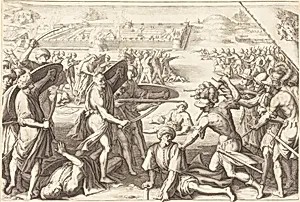
Assault on the Outer Forts of Bone
c. 1614
Medium
engraving on laid paper
Dimensions
sheet (trimmed to plate mark): 20 × 29.5 cm (7 7/8 × 11 5/8 in.)
Classification
Department
CG-E
Museum
National Gallery of Art, Washington, D.C.
Credit
R.L. Baumfeld Collection
Accession Number
1969.15.351
Rights
Public Domain
Art Historical Context
Jacques Callot's *Assault on the Outers of Bone* (c. 1614) captures the chaos of 17th-century siege warfare in a masterful engraving on laid paper, measuring 20 × 29.5 cm. As one of the Baroque era's premier printmakers, Callot (1592–1635) specialized in intricate scenes of military conflict, drawing from the turbulent conflicts in his native Lorraine region, including skirmishes involving local fortresses. This work likely depicts a dramatic assault during early European wars of religion and territorial disputes, where outer forts served as critical first lines of defense. Callot's engraving technique—incising fine lines into a metal plate for inking and printing—allowed for exceptional detail in rendering soldiers, cannon fire, and fortifications, even on a modest scale. Printed on laid paper, which shows the mesh marks from its handmade production, the piece exemplifies how prints democratized art, spreading vivid accounts of battles to a wide audience beyond the elite. Housed in the National Gallery of Art's R.L. Baumfeld Collection, it highlights Callot's skill in balancing action and precision, foreshadowing his later, more famous war series like *The Miseries and Misfortunes of War*. This engraving not only documents historical violence but also showcases the cultural role of prints as "news media" in an age before photography, inviting viewers to ponder the human cost of conquest.
About the Artist
Jacques Callot · 1592–1635
Jacques Callot (1592–1635) was a French printmaker and draftsman from the Duchy of Lorraine, widely regarded as one of the first great artists to practice the graphic arts exclusively. His more than 1,400 etchings chronicled the breadth of 17th-century life, from Medici court festivities to the brutal realities of warfare. Callot revolutionized etching through technical innovations including the é...