
蔦紅葉図|Autumn Ivy
after 1732
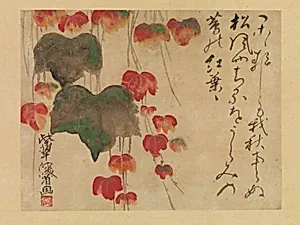
Medium
Album leaf mounted as a hanging scroll; ink, color, and gold on paper
Dimensions
Image: 8 3/8 x 10 7/8 in. (21.3 x 27.6 cm) Overall: 44 7/8 x 22 1/4 in. (114 x 56.5 cm)
Classification
Paintings
Culture & Period
Japan · Edo period (1615–1868)
Department
Asian Art
Museum
Metropolitan Museum of Art, New York, NY
Credit
The Harry G. C. Packard Collection of Asian Art, Gift of Harry G. C. Packard, and Purchase, Fletcher, Rogers, Harris Brisbane Dick, and Louis V. Bell Funds, Joseph Pulitzer Bequest, and The Annenberg Fund Inc. Gift, 1975
Accession Number
1975.268.67
Rights
Public Domain
Tags
Art Historical Context
Ogata Kenzan's *Autumn Ivy* (蔦紅葉図), after 1732 during Japan's Edo period (16151868), exemplifies the refined artistry of this master potter and painter. Originally an album leaf—intimate pages designed for private contemplation—this delicate work was later mounted as a hanging scroll transforming it into a stunning display piece. Rendered in ink, vibrant colors, and gold on paper, it measures just 8⅜ × 10⅞ inches, inviting viewers to savor its subtle elegance up close. The painting captures the poetic beauty of autumn ivy leaves, their rich reds and golds shimmering against a lavish gold ground—a hallmark of Rinpa-inspired aesthetics, though Kenzan infused his own whimsical, asymmetrical flair. This technique not only evokes seasonal transience (mono no aware), a core Japanese sensibility, but also highlights the medium's luminosity, where gold leaf mimics nature's fleeting glow. Housed in the Metropolitan Museum of Art's Asian Art Department, this piece from The Harry G. C. Packard Collection reflects Edo-era prosperity, when literati prized such nature motifs for meditation and display. Kenzan's fusion of pottery prowess and painting made him a cultural icon, bridging utilitarian art with high decoration. A quiet gem for visitors seeking Japan's harmonious blend of impermanence and splendor.
About the Artist
Ogata Kenzan · 1663–1743
Japanese, 1663–1743