
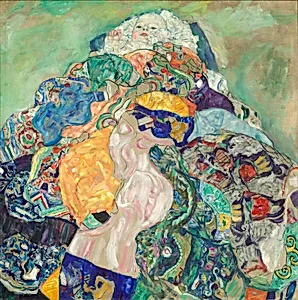
Baby (Cradle)
1917/1918
Medium
oil on canvas
Dimensions
overall: 110.9 x 110.4 cm (43 11/16 x 43 7/16 in.) framed: 116.21 x 115.89 x 6.67 cm (45 3/4 x 45 5/8 x 2 5/8 in.)
Classification
Painting
Department
CMC
Museum
National Gallery of Art, Washington, D.C.
Credit
Gift of Otto and Franziska Kallir with the help of the Carol and Edwin Gaines Fullinwider Fund
Accession Number
1978.41.1
Rights
Public Domain
Art Historical Context
Gustav Klimt's *Baby (Cradle)*, painted in 1917/1918, captures an intimate moment in oil on canvas, measuring a square 110.9 x 110.4 cm. One of the Austrian master's final works before his death in 1918, it depicts a cherubic infant nestled in a cradle, rendered with soft, luminous brushstrokes that emphasize form and gentle color harmonies rather than the ornate gold leaf and symbolism of his earlier masterpieces like *The Kiss*. Created amid the turmoil of World War I's final year, this painting reflects Klimt's late stylistic evolution. As a founder of the Vienna Secession and Art Nouveau pioneer, he shifted toward looser, more impressionistic techniques in his later oils, prioritizing emotional depth and everyday tenderness over decorative excess. The square format enhances its meditative quality, inviting viewers to contemplate innocence amid a war-weary Europe. Now housed in the National Gallery of Art, thanks to a generous gift from Otto and Franziska Kallir, *Baby (Cradle)* offers a poignant glimpse into Klimt's personal reflections on life and legacy. Its subtle palette and tender subject matter make it a hidden gem, bridging his iconic eroticism and symbolism with profound humanism.
About the Artist
Gustav Klimt · 1862–1918
Gustav Klimt was born on July 14, 1862, in Baumgarten near Vienna, the second of seven children in a modest family of artistic bent. His father, Ernst Klimt, a gold engraver who had immigrated from Bohemia, and his mother, Anna Finster, an aspiring musician, instilled an early appreciation for craft and creativity amid financial hardship. Klimt displayed prodigious drawing talent, prompting his en...