
Fritza Riedler
1906
Medium
Öl auf Leinwand
Dimensions
153 × 133 cm
Classification
Gemälde
Department
Belvedere Collection
Museum
Belvedere
Credit
Belvedere, Vienna
Accession Number
3379
Rights
Public Domain
About this artwork
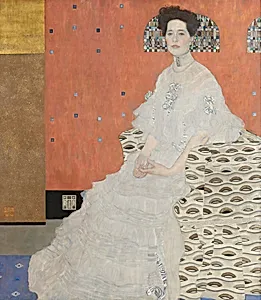
Würdevoll, zurückhaltend, majestätisch thront Fritza Riedler (1860–1927), die Gattin eines wohlhabenden Maschinenbauingenieurs, im Sessel. Die feinen Züge ihres blassen Gesichts stehen in wirkungsvollem Kontrast zum dunklen Haar. Kein Mienenspiel, nicht die kleinste Regung erlaubt Rückschlüsse auf das Innere der Porträtierten. Gustav Klimt verbindet die naturnahe Wiedergabe seines Modells mit einer ornamentalen Auflösung des Umfeldes. Selbst das Sitzmöbel wird zum Ornament aus Wellenbändern und ...
Art Historical Context
Gustav Klimt’s 1906 portrait captures Fritza Riedler, the wife of a prosperous Viennese mechanical engineer, seated with quiet dignity. Painted during the artist’s celebrated Golden Period, the work reflects the refined elegance of early twentieth-century Viennese society while showcasing Klimt’s distinctive approach to portraiture. The sitter’s pale features and dark hair are rendered with lifelike precision, yet her expression remains composed and unreadable, inviting viewers to ponder the inner life she keeps private. Klimt masterfully balances realism and ornament. While Riedler’s face and hands are depicted naturalistically, the surrounding space dissolves into intricate patterns. The armchair transforms into a decorative motif of flowing wave bands and ancient Egyptian eye symbols, flattening the picture plane even as the figure seems to occupy real space. This tension between depth and surface decoration is a hallmark of Klimt’s style during these years. Housed in the Belvedere Collection in Vienna, the painting exemplifies the innovative spirit of the Vienna Secession, of which Klimt was a leading figure. Its blend of psychological reserve and lavish ornament continues to fascinate visitors today.
About the Artist
Gustav Klimt · 1862–1918
Gustav Klimt was born on July 14, 1862, in Baumgarten near Vienna, the second of seven children in a modest family of artistic bent. His father, Ernst Klimt, a gold engraver who had immigrated from Bohemia, and his mother, Anna Finster, an aspiring musician, instilled an early appreciation for craft and creativity amid financial hardship. Klimt displayed prodigious drawing talent, prompting his en...