
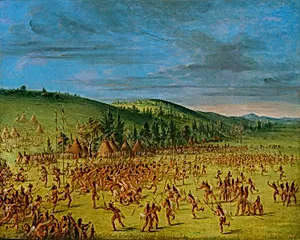
Ball-play of the Choctaw--Ball Up
1846-1850
Medium
Painting
Classification
Painting
Department
Smithsonian Collection
Museum
Smithsonian American Art Museum
Credit
Smithsonian American Art Museum, Gift of Mrs. Joseph Harrison, Jr.
Accession Number
1985.66.428A
Rights
Public Domain
Tags
About this artwork
In 1834, George Catlin witnessed Choctaw lacrosse in Indian Territory near present-day Oklahoma, and was captivated by the game. He described ball-play as “a school for the painter or sculptor, equal to any of those which ever inspired the hand of the artist in the Olympian games or the Roman forum.” Lacrosse, which involved a no-holds-barred struggle for the ball, was a physical, even violent, game called “little brother of war” in Choctaw.
Art Historical Context
George Catlin's *Ball-play of the Choaw--Ball Up* (1846-1850) pulses with the raw energy of Native American life, capturing a dynamic group of Choctaw players locked in a fierce struggle for the ball. Set against a backdrop of teepees, oil painting freezes the chaotic thrill of this traditional game—a no-holds-barred contest that presaged modern lacrosse. Catlin, a pioneering 19th-century artist devoted to documenting Indigenous cultures, painted this as part of his vast Indian Gallery, created from sketches made during his travels. In 1834, Catlin witnessed Choctaw lacrosse in Indian Territory (near present-day Oklahoma) and was utterly captivated. He rhapsodized it as "a school for the painter or sculptor, equal to any of those which ever inspired the hand of the artist in the Olympian games or the Roman forum." Known to the Choctaw as the "little brother of war," the game tested physical endurance and skill in a violent, communal ritual. This Smithsonian American Art Museum treasure underscores Catlin's urgent mission to preserve vanishing Native traditions amid U.S. expansion. Its vivid figures and motion evoke both artistic drama and profound cultural respect, inviting viewers to feel the heartbeat of Choctaw heritage.
About the Artist
George Catlin · 1796–1872
George Catlin (1796–1872), born in Wilkes-Barre, Pennsylvania, to Putnam Catlin and Polly Sutton—who had been captured by Native Americans during the 1778 Battle of Wyoming—initially pursued a legal career. Trained at Litchfield Law School, he was admitted to the bar in 1819 but abandoned law after two years to study art in Philadelphia in 1823. Self-taught as a portraitist, Catlin quickly gained ...