
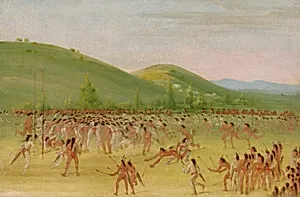
Ball-play of the Choctaw--Ball Down
1834-1835
Medium
Painting
Classification
Painting
Department
Smithsonian Collection
Museum
Smithsonian American Art Museum
Credit
Smithsonian American Art Museum, Gift of Mrs. Joseph Harrison, Jr.
Accession Number
1985.66.429
Rights
Public Domain
Tags
About this artwork
In Choctaw lacrosse, which George Catlin witnessed in 1834, each team was cheered on by friends, family, and fans who camped at the opposite ends of the field to watch the game and bet on its outcome. Catlin noted that women did much of the wagering, which involved “knives-dresses-blankets-pots and kettles-dogs and horses, and guns.”
Art Historical Context
George Catlin's *Ball-play of the Choaw--Ball Down* (1834-1835) captures a dynamic moment in a traditional Choctaw lacrosse game, *isht aboli*, which the artist personally witnessed that year during his travels through Native American territories. As a pioneering 19th-century painter dedicated to documenting Indigenous life before widespread displacement, Catlin created this oil painting as part of his vast "Indian Gallery," a collection aimed at preserving cultures for future generations. His realistic style, rooted in Romanticism, emphasizes the vigor and communal spirit of the players, frozen in the instant the ball hits the ground. The scene vividly portrays the intensity of the match, with teams of male players vying fiercely on a long field, cheered by crowds of friends, family, and fans encamped at opposite ends. Catlin highlighted the lively betting culture, noting that women wagered boldly on knives, dresses, blankets, pots, kettles, dogs, horses, and guns—reflecting the game's deep social and economic role in Choctaw society. This artwork not only showcases athletic prowess but also underscores the cultural richness of Southeastern tribes, offering museum visitors a window into pre-removal Native traditions. Today, housed in the Smithsonian American Art Museum, the painting reminds us of Catlin's urgent mission amid U.S. expansion, blending ethnography with artistry to celebrate Indigenous resilience.
About the Artist
George Catlin · 1796–1872
George Catlin (1796–1872), born in Wilkes-Barre, Pennsylvania, to Putnam Catlin and Polly Sutton—who had been captured by Native Americans during the 1778 Battle of Wyoming—initially pursued a legal career. Trained at Litchfield Law School, he was admitted to the bar in 1819 but abandoned law after two years to study art in Philadelphia in 1823. Self-taught as a portraitist, Catlin quickly gained ...