
Bassoon in C
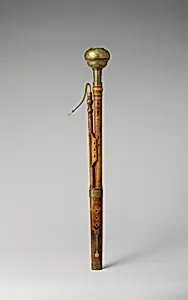
Medium
Maple, brass
Dimensions
Length (end to end) 1146 mm, Length of tube +/-2438 mm including crook and reed, Diameter of bell (opening) 76 mm Length of crook +/- 366 mm Length of wing section +/- 495 mm without tenon Length of butt section 425 mm Length of long section +/- 530 mm without tenon Length of bell 215 mm
Classification
Aerophone-Reed Vibrated-double reed
Culture
Swiss
Department
Musical Instruments
Museum
Metropolitan Museum of Art, New York, NY
Credit
The Crosby Brown Collection of Musical Instruments, 1889
Accession Number
89.4.883
Rights
Public Domain
Art Historical Context
Crafted in 1771 by the esteemed Jeanneret workshop in Switzerland, this Bassoon in C exemplifies the masterful woodworking traditions of 18th-century Europe. Fashioned from resonant maple wood with brass fittings, it measures an impressive 1146 mm in assembled length, with a coiled tube extending to about 2438 mm including the crook and reed. Its elegant sections—wing (495 mm), butt (425 mm), long joint (530 mm), bell (215 mm with a 76 mm opening), and crook (366 mm)—reflect the intricate joinery techniques that allowed for the bassoon's distinctive folded design, enabling portability while producing its deep, reedy tones. As a double-reed aerophone, this instrument played a vital role in Baroque and early Classical orchestras, providing rich bass lines and expressive solos. Swiss makers like the Jeannerets were renowned for their precision, contributing to the evolution of woodwinds during a golden age of musical innovation. The maple's fine grain ensured superior acoustics, while brass elements added durability and a touch of ornamental flair. Now housed in the Metropolitan Museum of Art's Crosby Brown Collection of Musical Instruments (acquired 1889), this bassoon offers a tangible link to Enlightenment-era music culture, inviting visitors to appreciate the artistry behind the sound.