
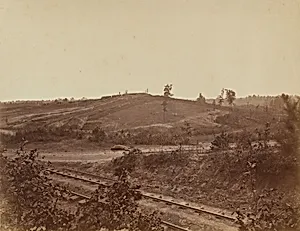
Battlefield in Atlanta
Medium
albumen print
Dimensions
image/sheet: 27.8 × 35.9 cm (10 15/16 × 14 1/8 in.) mount: 45.5 × 55.8 cm (17 15/16 × 21 15/16 in.)
Classification
Photograph
Department
CPH
Museum
National Gallery of Art, Washington, D.C.
Credit
Patrons' Permanent Fund
Accession Number
1995.36.12
Rights
Public Domain
Art Historical Context
**Battlefield in Atlanta**, captured by George N. Barnard 1864, offers a stark glimpse into the devastation of the American Civil War As General William T. Sherman's Union forces laid siege to Atlanta that summer—a turning point that boosted Northern morale and paved the way for his infamous March to the Sea—ard, Sherman's official photographer, documented scarred landscape. This albumen print preserves the chaotic aftermath: shattered earth, abandoned artillery, and the grim remnants of conflict, evoking the human toll of one of the war's bloodiest campaigns. The albumen print medium, popular in the mid-19th century, highlights Barnard's technical prowess. Made from a glass negative and coated with egg-white albumen sensitized with silver salts, it yields exquisite detail, warm tones, and a luminous quality that brings the scene to life. At 27.8 × 35.9 cm, this intimate yet monumental view (mounted larger for display) exemplifies early war photography's shift from staged portraits to raw, on-the-ground realism. Housed in the National Gallery of Art, this work underscores photography's emerging role as a historical witness, bridging art and journalism. It invites visitors to reflect on Atlanta's fall—not just a military victory, but a symbol of Southern resilience amid ruin—reminding us how images like Barnard's endure as poignant testaments to war's enduring scars.
About the Artist
George N. Barnard · 1819–present
George N. Barnard (1819–1902) was a pioneering American photographer whose six-decade career spanned the dawn of the medium, from daguerreotypes to Civil War documentation. Born into a farming family in Coventry, Connecticut, on December 23, 1819, he lost his father at age seven and apprenticed in family businesses before marrying in 1843 and relocating to Oswego, New York. There, he launched one ...