
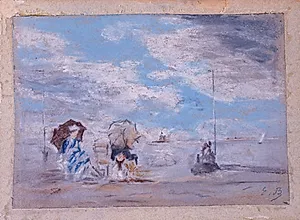
Beach Scene
ca. 1882–83
Medium
Pastel on gray wove paper mounted on card
Dimensions
5 3/4 × 8 3/16 in. (14.6 × 20.8 cm) Framed: 16 1/4 × 21 1/4 in. (41.3 × 54 cm)
Classification
Drawings
Department
Robert Lehman Collection
Museum
Metropolitan Museum of Art, New York, NY
Credit
Robert Lehman Collection, 1975
Accession Number
1975.1.573
Rights
Public Domain
Tags
Art Historical Context
Eugène Boudin's *Beach Scene* (ca. 1882–83) captures the leisurely charm of coastal life in a delicate pastel on gray wove paper, just 5 3/4 × 8 3/16 inches. This intimate drawing, now in the Robert Lehman Collection at The Metropolitan Museum of Art, depicts elegant women strolling along the shore—a recurring motif in Boudin's work As a master of plein air painting, the French artist (1824–8) frequented Normandy and Brittany beaches, sketching directly from nature to evoke the transient effects of light and sea air. Boudin, often called the "king of skies," bridged Realism and Impressionism, profoundly influencing Claude Monet, whom he mentored. His beach scenes celebrated the emerging 19th-century bourgeoisie at play, blending atmospheric landscapes with subtle figures. This small-scale pastel exemplifies his rapid, expressive technique: the soft, blendable medium on toned gray paper allowed for luminous highlights and subtle shadows, mimicking the shimmering quality of sunlight on water and sand. Housed in The Met since 1975, *Beach Scene* invites visitors to appreciate Boudin's innovative fusion of drawing and color, a precursor to the bold strokes of Impressionism. Its modest size belies its cultural snapshot of Victorian-era seaside leisure.
About the Artist
Eugène Boudin · 1824–1898
Eugène Louis Boudin was born on July 12, 1824, in Honfleur, Normandy, the son of a harbor pilot. When his family relocated to Le Havre, his father opened a stationery and picture-framing shop, and it was there that the young Boudin first encountered working artists. Artists such as Constant Troyon and Jean-François Millet recognized his talent and urged him toward a career in art. In 1850, a munic...