
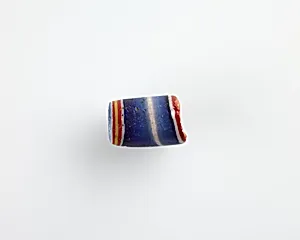
Bead, cylindrical; longitudinal bore
305 BCE-14 CE
Classification
Jewelry and Ornament
Department
Smithsonian Collection
Museum
Smithsonian American Art Museum
Credit
Gift of Charles Lang Freer
Accession Number
F1909.822
Rights
Public Domain
Tags
About this artwork
To 1909
Art Historical Context
This delicate cylindrical bead, featuring a longitudinal bore for stringing, hails from ancient Egypt during the Ptolemaic Dynasty (305–30 BCE) and into the early Roman Period ( to 14 CE). Crafted as part of the everyday jewelry and ornaments worn by Egyptians, it exemplifies the enduring tradition of beadwork that symbolized status, protection, and beauty across millennia. Beads like this were strung into necklaces, bracelets, and belts, often traded widely across the Mediterranean. Likely made of mosaic glass—a sophisticated technique where colorful glass rods were fused, sliced, and arranged to create intricate patterns—this bead showcases the technical prowess of Ptolemaic artisans. Under Greek-influenced Ptolemaic rule, Egyptian glassmaking blended local traditions with Hellenistic innovations, producing vibrant, durable pieces that mimicked precious stones. Its survival into the Roman era highlights Egypt's cultural continuity amid imperial shifts. Acquired by collector Charles Lang Freer before 1909 and gifted to the Smithsonian American Art Museum, this unassuming artifact offers a tangible link to daily life in one of antiquity's great civilizations. Visitors can appreciate how such simple adornments carried profound cultural weight in a world of pharaohs and emperors.
About the Artist
Unknown
The artist designated as "Unknown" in our virtual museum's collection exemplifies a poignant chapter in art history: creators whose identities have faded into obscurity despite the enduring power of their work. With only one known artwork attributed to them in our holdings, this figure represents countless anonymous hands that shaped visual culture across centuries. Museums worldwide, including th...