
Bishop Hill: Mangler
c. 1939
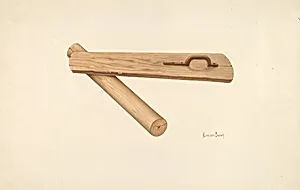
Medium
watercolor and graphite on paperboard
Dimensions
overall: 33.2 x 45.5 cm (13 1/16 x 17 15/16 in.) Original IAD Object: 26" long; 5" wide
Classification
Index of American Design
Department
CG-W
Museum
National Gallery of Art, Washington, D.C.
Credit
Index of American Design
Accession Number
1943.8.3916
Rights
Public Domain
Art Historical Context
**Bishop Hill: Mangler is a captivating watercolor and graphite rendering on paperboard created around 1939 by H. Langden Brown. Measuring 33.2 x 45.5 cm, this work faithfully documents a traditional wooden "mangler"—a folk tool used for pressing and smoothing fabrics, likely originating from the Swedish utopian community of Bishop Hill,. Brown's meticulous technique combines the fluidity of watercolor for vibrant tones with graphite's precision for fine details, capturing the object's simple yet elegant form: originally 26 inches long and 5 inches wide. As part of the Index of American Design (IAD), a Works Progress Administration (WPA) project from the Great Depression era (1935–1942), this piece exemplifies a national effort to celebrate and preserve everyday American craftsmanship. Over 18,000 such renderings were produced by artists across the U.S., highlighting regional folk arts and designs that reflected cultural heritage. Bishop Hill, founded in 1846 by Swedish immigrants, was renowned for its skilled woodworking and communal traditions, making the mangler a poignant symbol of immigrant ingenuity. Today, housed in the National Gallery of Art's collection, Brown's artwork invites us to appreciate the beauty in utilitarian objects, bridging art history with America's diverse cultural tapestry. It's a reminder of how federal initiatives like the IAD not only supported artists but also safeguarded stories of ordinary life.
About the Artist
H. Langden Brown · 1879–1960
H. Langden Brown (1879–1960) was an American artist best known for his contributions to the Index of American Design, a Federal Art Project under the Works Progress Administration (WPA) from 1935 to 1942. This ambitious initiative commissioned artists across the United States to create meticulous watercolor renderings of everyday objects, tools, vehicles, and crafts that embodied the nation's folk...