
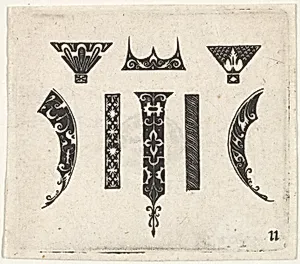
Blackwork Print with Eight Motifs
Medium
blackwork
Dimensions
Plate: 1 3/4 x 2 1/16 in. (4.5 x 5.2 cm)
Classification
Prints|Ornament & Architecture
Department
Drawings and Prints
Museum
Metropolitan Museum of Art, New York, NY
Credit
The Elisha Whittelsey Collection, The Elisha Whittelsey Fund, 1956
Accession Number
56.500.115
Rights
Public Domain
Tags
Art Historical Context
Step into the intricate world of 17th-century Dutch ornament with *Blackwork Print with Eight Motifs*, a engraving created around 1620 by Claesz. Visscher, a prolific Amsterdam publisher and engraver, in collaboration with Georg Arnoldt Measuring just 1¾ x 2⅛ inches, this plate from the Metropolitan Museum of Art's Drawings and Prints department captures eight delicate decorative motifs, likely inspired by architecture and scrolling foliage—hallmarks of the era's opulent design aesthetic. The blackwork technique, rendered in fine black lines on white paper, exemplifies the precision of early modern printmaking. Visscher's workshop specialized in such reproductive prints, using etching or engraving to produce sharp, reproducible patterns that could be easily transferred to other surfaces. This medium was revolutionary for its affordability and clarity, allowing widespread dissemination of complex designs without losing detail. During the Dutch Golden Age, prints like this served as essential pattern books for artisans crafting lace, embroidery, metalwork, and architectural embellishments. They bridged the gap between elite patronage and everyday craftsmanship, fueling Europe's decorative arts boom and reflecting the period's fascination with symmetry and natural forms. A gem from The Elisha Whittelsey Collection, it invites us to appreciate how such tiny works shaped grand visual cultures.
About the Artist
Claes Jansz. Visscher|Georg Arnoldt · 1586–1652
Claes Jansz. Visscher, also known as Nicolas Joannis Visscher II or Joannis Piscator, was a prominent Dutch Golden Age draughtsman, engraver, mapmaker, and publisher born in Amsterdam in 1587 and died there on June 19, 1652. The son of the printmaker and publisher Jan Claesz. Visscher (c. 1550–1612), he learned the art of etching and printing from his father, helping to expand the family trade int...