
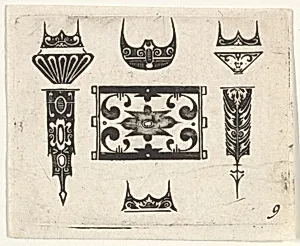
Blackwork Print with Nine Motifs
ca. 1620
Medium
blackwork
Dimensions
Plate: 1 9/16 x 2 in. (3.9 x 5.1 cm)
Classification
Prints|Ornament & Architecture
Department
Drawings and Prints
Museum
Metropolitan Museum of Art, New York, NY
Credit
The Elisha Whittelsey Collection, The Elisha Whittelsey Fund, 1956
Accession Number
56.500.113
Rights
Public Domain
Tags
Art Historical Context
Created around 1620 by the Dutch printmaker Claes Jansz. Visscher, this tiny blackwork print showcases nine intricate ornamental motifs arranged in a compact grid. Measuring just over an inch and a half wide, the plate exemplifies the delicate engraving techniques popular during the Dutch Golden Age. Visscher, known for his maps and landscape views as well as ornamental designs, used fine lines and dense patterns to create elegant, repeatable motifs that could inspire artisans working in embroidery, metalwork, or furniture decoration. Blackwork prints like this one served as pattern books for craftsmen across Europe, spreading fashionable Renaissance and Baroque designs far beyond the artist’s studio in Amsterdam. Their small size made them affordable and easy to circulate, helping to democratize access to sophisticated decorative ideas. Today, this delicate sheet in the Metropolitan Museum’s collection offers a charming glimpse into the everyday creativity of the seventeenth century, reminding us how even the smallest prints shaped the visual world of their time.
About the Artist
Claes Jansz. Visscher · 1586–1652
Claes Jansz. Visscher, also known as Nicolas Joannis Visscher II or Joannis Piscator, was a prominent Dutch Golden Age draughtsman, engraver, mapmaker, and publisher born in Amsterdam in 1587 and died there on June 19, 1652. The son of the printmaker and publisher Jan Claesz. Visscher (c. 1550–1612), he learned the art of etching and printing from his father, helping to expand the family trade int...