
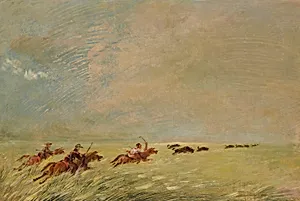
Bogard, Batiste, and I Chasing Buffalo in High Grass on a Missouri Bottom
1837-1839
Medium
Painting
Classification
Painting
Department
Smithsonian Collection
Museum
Smithsonian American Art Museum
Credit
Smithsonian American Art Museum, Gift of Mrs. Joseph Harrison, Jr.
Accession Number
1985.66.486
Rights
Public Domain
Tags
About this artwork
“In this voyage, Ba'tiste and Bogard were my constant companions; and we all had our rifles, and used them often. We often went ashore amongst the herds of buffaloes, and were obliged to do so for our daily food. We lived the whole way on buffaloes' flesh and venison . . . We met immense numbers of buffaloes in the early part of our voyage and used to land our canoe almost every hour in the day; and often times all together approach the unsuspecting herds, through some deep and hidden ravine wit...
Art Historical Context
George Catlin’s *Bogard, Batiste, and I Chasing Buffalo in High Grass on a Missouri Bottom* (1837–1839) captures a vivid moment from the artist’s travels along the Upper Missouri River. A self-portrait, the painting shows Catlin alongside his companions Bogard and Ba’tiste as they pursue bison on horseback through tall prairie grass. Catlin sketched the scene during his 1832 expedition but completed the canvas several years later, drawing on his firsthand experiences living off buffalo and venison while traveling by canoe. Catlin’s work belongs to his larger project of documenting the American West and its Indigenous cultures at a time of rapid change. His paintings served as both artistic records and ethnographic documents, offering Eastern audiences some of their first visual encounters with the region’s vast landscapes and wildlife. The Smithsonian American Art Museum holds this work as part of the collection donated by Mrs. Joseph Harrison, Jr., preserving Catlin’s firsthand account of frontier life. The painting’s energetic composition conveys both the thrill of the hunt and the abundance of the pre-settlement plains. Through dynamic poses and sweeping grasslands, Catlin invites viewers to imagine the scale of the buffalo herds that once defined the Missouri River valley.
About the Artist
George Catlin · 1796–1872
George Catlin (1796–1872), born in Wilkes-Barre, Pennsylvania, to Putnam Catlin and Polly Sutton—who had been captured by Native Americans during the 1778 Battle of Wyoming—initially pursued a legal career. Trained at Litchfield Law School, he was admitted to the bar in 1819 but abandoned law after two years to study art in Philadelphia in 1823. Self-taught as a portraitist, Catlin quickly gained ...