
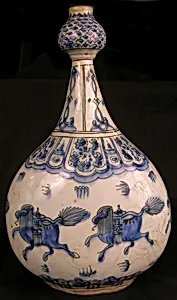
Bottle with Running Quadrupeds
Unknown Artist
17th century
Medium
Stonepaste; painted in blue under transparent glaze
Dimensions
H. 12 5/16 in. (31.3 cm) Gr. D. 7 15/16 in. (20.2 cm)
Classification
Ceramics
Department
Islamic Art
Museum
Metropolitan Museum of Art, New York, NY
Credit
Rogers Fund, 1970
Accession Number
1970.38
Rights
Public Domain
Tags
Art Historical Context
This elegant 17th-century ceramic, titled *Bottle with Running Quadeds*, exemplifies the refined artistry of Islamic potters. Standing at 12 5/16 inches with a greatest diameter of nearly 8 inches, it features dynamic scenes of bounding animals painted in vibrant blue under a transparent glaze on a stonepaste body. Stonepaste, a composite of quartz, clay, and frit, was a hallmark innovation in Islamic ceramics from the medieval period onward, allowing for thin-walled vessels that mimicked the sheen of Chinese porcelain while enabling intricate designs. Crafted in the Islamic world during the 17th century—a golden age for such wares under empires like the Safavids and Ottomans—this bottle highlights the mastery of underglaze painting. The technique involved applying cobalt blue pigment directly onto the unfired body before glazing and firing, creating enduring, luminous colors resistant to fading. Animal motifs like running quadrupeds were popular in Islamic decorative arts, symbolizing vitality and movement, often drawing from nature or hunting scenes without direct religious iconography. Now housed in the Metropolitan Museum of Art's Islamic Art Department (acquired via the Rogers Fund in 1970), this piece invites visitors to appreciate how everyday objects became canvases for storytelling and technical virtuosity, bridging utility and beauty in a vibrant cultural tradition.