
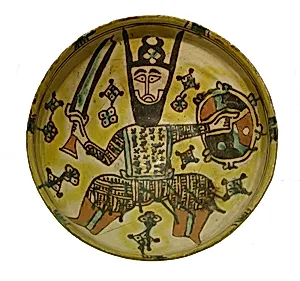
Bowl with a Man Holding a Sword and Shield
Unknown Artist
10th century
Medium
Earthenware; white slip with black slip and polychrome pigments under transparent colorless glaze
Dimensions
H. 4 5/8 in. (11.7 cm) Diam. 10 1/2 in. (26.7 cm) Wt. 35.4 oz. (1003.7 g)
Classification
Ceramics
Department
Islamic Art
Museum
Metropolitan Museum of Art, New York, NY
Credit
Louis V. Bell Fund, 1966
Accession Number
66.176
Rights
Public Domain
Tags
Art Historical Context
This exquisite 10th-century earthenware bowl, measuring 4⅝ inches high and 10½ inches in diameter, showcases a dynamic figure of a man clad in armor, gripping a sword in one hand and a shield in the other. Crafted in the Islamic tradition, its surface is adorned with white slip as a base, accented by black slip outlines and vibrant polychrome pigments—all sealed under a transparent colorless glaze. This technique, pioneered in the Abbasid era (roughly 8th–13th centuries), allowed artisans to achieve luminous, durable colors on everyday objects, transforming functional ceramics into artistic treasures. Housed in the Metropolitan Museum of Art's Islamic Art Department (acquired via the Louis V. Bell Fund in 1966), the bowl hails from a golden age of ceramic innovation in regions like Iraq and Persia. Such vessels were not only used for food and drink but also served as canvases for storytelling, often depicting warriors symbolizing heroism, protection, or chivalric ideals from epic poetry and folklore. The bold portrayal of the armed man reflects the cultural valorization of martial prowess in medieval Islamic societies, where shields and swords evoked both real-life defenders and mythical heroes. Its hefty 35.4-ounce weight underscores the robust craftsmanship, making this bowl a vivid window into the artistry and worldview of a thriving civilization.