
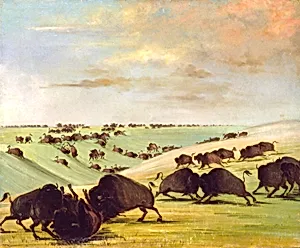
Buffalo Bulls Fighting in Running Season, Upper Missouri
1837-1839
Medium
Painting
Classification
Painting
Department
Smithsonian Collection
Museum
Smithsonian American Art Museum
Credit
Smithsonian American Art Museum, Gift of Mrs. Joseph Harrison, Jr.
Accession Number
1985.66.424
Rights
Public Domain
Tags
About this artwork
“The ‘running season,’ which is in August and September, is the time when [the buffalo] congregate into such masses in some places, as literally to blacken the prairies for miles together. It is no uncommon thing at this season, at these gatherings, to see several thousands in a mass, eddying and wheeling about under a cloud of dust, which is raised by the bulls as they are pawing in the dirt, or engaged in desperate combats, as they constantly are, plunging and butting at each other in the most...
Art Historical Context
George Catlin's *Buffalo Bulls Fighting in Running Season, Upper Missouri* (1837-1839) captures the raw energy of the American West during the buffalo's frenzied "running season" in August and September. As a pioneering artist who traveled the Great Plains in the 1830s, Catlin documented the landscapes, wildlife, and Native American life of the Upper Missouri River region before rapid settlement transformed it forever. This painting, now in the Smithsonian American Art Museum's collection (gift of Mrs. Joseph Harrison, Jr.), vividly portrays massive herds blackening the prairies, with bulls locked in fierce combats amid clouds of dust. In his own words from *Letters and Notes* (1841), Catlin described these scenes: herds of thousands eddying under dust clouds, bulls pawing the earth and butting furiously while pursuing females, all accompanied by thunderous roars echoing like distant storms. Though the medium is unknown, the work exemplifies Catlin's commitment to ethnographic realism, blending observation with dramatic composition to convey the scale and chaos of untamed nature. This artwork holds cultural significance as a window into the pre-industrial American frontier, highlighting the buffalo's vital role in Plains Indian life and ecology. It reminds visitors of a dynamic wilderness now largely lost, preserving a moment of ecological spectacle for future generations.
About the Artist
George Catlin · 1796–1872
George Catlin (1796–1872), born in Wilkes-Barre, Pennsylvania, to Putnam Catlin and Polly Sutton—who had been captured by Native Americans during the 1778 Battle of Wyoming—initially pursued a legal career. Trained at Litchfield Law School, he was admitted to the bar in 1819 but abandoned law after two years to study art in Philadelphia in 1823. Self-taught as a portraitist, Catlin quickly gained ...