
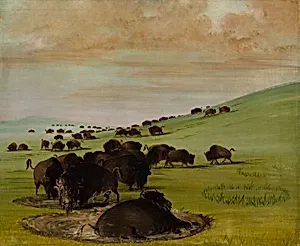
Buffalo Bulls in a Wallow
1837-1839
Medium
Painting
Classification
Painting
Department
Smithsonian Collection
Museum
Smithsonian American Art Museum
Credit
Smithsonian American Art Museum, Gift of Mrs. Joseph Harrison, Jr.
Accession Number
1985.66.425
Rights
Public Domain
Tags
About this artwork
“In the heat of summer,” George Catlin wrote, “these huge animals, which no doubt, suffer very much with the great profusion of their long and shaggy hair or fur, often graze on the low grounds in the prairies, where there is a little stagnant water lying amongst the grass, and the ground underneath being saturated with it, is soft, into which the enormous bull, lowered down upon one knee, will plunge his horns, and at last his head, driving up the earth, and soon making an excavation in the gro...
Art Historical Context
George Catlin's *Buffalo Bulls in aallow* (1837–1839) captures a vivid moment from the American prairies during his pioneering expeditions into the Western frontier. As one of the first artists to Native American life and wildlife before widespread settlement, Catlin painted this oil-on-canvas scene after observing bison herds firsthand. The work belongs to his extensive series of over 600 portraits and landscapes, now housed in the Smithsonian American Art Museum, emphasizing the raw beauty and untamed spirit of the 19th-century Plains. In Catlin's own colorful words from his 1841 *Letters and Notes*, the massive bulls plunge into soft, water-saturated earth, wallowing like "hogs in mire" to cool off under summer heat. Their rotary motions churn mud into a "complete mortar," transforming them into "hideous monsters of mud and ugliness." This realistic depiction highlights Catlin's keen eye for animal behavior and natural drama, using earthy tones and dynamic composition to immerse viewers in the scene. Beyond artistry, the painting underscores the bison's cultural and ecological role—vital to Indigenous peoples—while preserving a vanishing world amid encroaching change. A true window into America's wild heart!
About the Artist
George Catlin · 1796–1872
George Catlin (1796–1872), born in Wilkes-Barre, Pennsylvania, to Putnam Catlin and Polly Sutton—who had been captured by Native Americans during the 1778 Battle of Wyoming—initially pursued a legal career. Trained at Litchfield Law School, he was admitted to the bar in 1819 but abandoned law after two years to study art in Philadelphia in 1823. Self-taught as a portraitist, Catlin quickly gained ...