
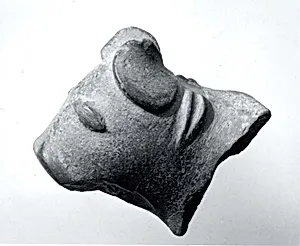
Bull head-shaped spout of vessel
Unknown Artist
4th–3rd millennium BCE (?)
Medium
Stone
Dimensions
2.25 x 2.5 in. (5.72 x 6.35 cm)
Classification
Stone-Vessels
Department
Ancient Near Eastern Art
Museum
Metropolitan Museum of Art, New York, NY
Credit
Gift of Walter Hauser, 1955
Accession Number
55.65.1
Rights
Public Domain
Tags
Art Historical Context
This exquisite bull head-shaped spout, from stone in the 4th–3rd millennium BCE, hails from the ancient Near East—a cradle of early civilization where masterful stonework adorned everyday and ritual vessels. Measuring just 2.25 x 2.5 inches this diminutive artifact, now in the Metropolitan Museum of's Ancient Near Eastern Art (gift of Walter Hauser 1955), likely served as functional pourer for a larger vessel, blending utility with symbolic power. Bulls held profound cultural importance in these prehistoric societies, embodying strength, fertility, and divine authority—motifs echoed in later Mesopotamian art. The unknown artisan's skill shines in the detailed carving of the bull's features, from alert ears to a fierce snout, achieved through precise stone subtraction techniques suited to hard materials like this. Such vessels were prized possessions, possibly used in rituals or elite households, offering a glimpse into the ingenuity of Chalcolithic or early Bronze Age craftsmen. Pause to admire how this tiny survivor captures the awe-inspiring vitality of ancient beliefs, reminding us of humanity's enduring fascination with the animal world.